Research

Tom Philips (1997) observed that by the “virtue of its massive displacement of air… the grand piano can furnish a room and inform a space” (p. 102). In this sense, we can metaphorically view the instrument as a blank canvas for the art of music-making. A pianist must, therefore, have in his or her possession the tools and techniques necessary to create a ‘sound painting’.
For example, the music Alexander Scriabin wrote after his injury contained mostly three-note chords instead of four or five-note ones in the right hand and many large stretches in the left-hand. Eckart Altenmüller (2015) pointed out that “this would become a characteristic of his style, as are the wide spans in the left hand” (p.209).

Hamish Keith stated that it is “a basic tenet of European art history that you can tell the difference between a bit of Dutch paint from a bit of Italian paint… art is as much as about how things are done as about what is carved or painted” (Copland, 2007, episode 4).

It should, however, be noted that technique cannot be “created in a vacuum just as you cannot create a form devoid of any content… such a ‘form’ is equal to zero and does not, in fact, exist” (Neuhaus, 1973, p. 82).

Action Painting and Piano Technique


Action Painting is exemplified by the daring, gestural works of painter Franz Kline, who creates the illusion that a painting contains movement. Artists who practice action painting would throw, splash, pour and even use their bodies to apply paint onto a canvas.

Example of Action Painting: Franz Kline’s Abstraction (1955)

Helmut Lachenmann’s Guero has the pianist play the surface of the keys (never depressing them) as though he or she was an action painter:

Score excerpt from Guero

In whorl by Eve de Castro-Robinson, the artist/performer is instructed to employ a circular motion of the wrist and arms to create the work: 

Realisation of whorl

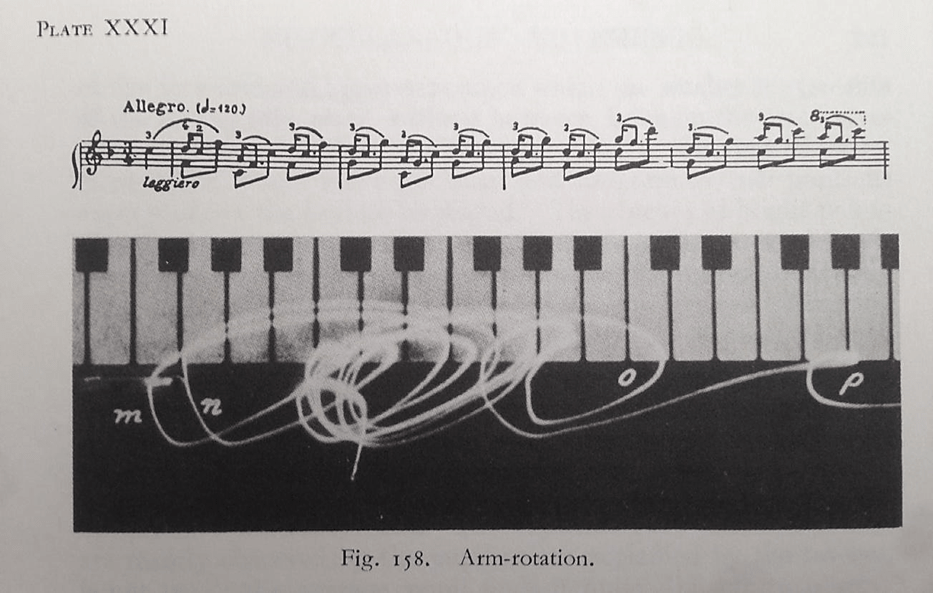
The following pantograph by Otto Ortmann (1981/1929, p. 291) shows a real-life example of a pianist’s circular arm rotations whilst playing a passage from a Chopin Étude:

Pantograph showing circular movement of a pianist’s right hand and wrist

In this composition by George Crumb, the pianist is instructed to strum the piano’s strings in a circular manner:

The beginning of the 7th movement from Makrokosmos, vol. 1

In the following examples by Seymour Fink the pianist is encouraged to develop healthy, circular movements to facilitate smooth phrasings (Fink, 2002, p. 62). Note the squiggles used to indicate the desired movements in the player’s wrist:

Glitch Art and Piano Technique


Digital technology has been used actively and successfully by artists since the mid-1960s (Candy and Edmonds, 2002), and glitches in digital images and audio have been harnessed by artists who cast the ‘errors’ under an artistic light. A glitch artist might, among other things, open an image file as a text file, delete or insert text and reopen the (glitched) image. He or she could also convert an audio file into a raw format, open it up in Photoshop as an ‘image’ and play around with it that way.

Example of Glitch Art

Wrong notes (i.e. dissonance), bad rhythm and other unwanted noises could similarly be categorised as glitches in a musical performance. Composers, however, could deliberately make use of these in their music. Steven Holtzman (1994) noted that historically, dissonance has been relative and that today, “scratching sounds and noise are now part of the accepted sound world of rap music and MTV” (p.253, 254).  

A parallel pianistic realisation of glitch art can be seen in György Ligeti’s Touches bloquées. In this étude, the right-hand start by playing semi-tone runs: 

The left hand, however, causes ‘problems’ by silently holding down three notes:

The effect created is a little irritating and creates the impression that there is a glitch in the music – as if though some notes on the piano are broken:

Cross-Hatching and Piano Technique


Cross-hatching is simply a shading technique artists use in drawing, engraving and etching. The crossing parallel lines of cross-hatching could have varying degrees of density, line thickness and contours (to form shapes).

Example of Cross-Hatching

Cross hatching : r/drawing

In the third bagatelle from Carl Vine’s Five Bagatelles, the composer crosses the hands in a manner that visually (and sonically) appears as a pianistic equivalent to cross-hatching:

Debussy’s Prelude no. 12, Book II also makes use of of ‘pianistic cross-hatching’:

Stippling and Piano Technique


In drawing, engraving and painting, stippling refers to the marking of a surface with numerous small dots of specks to create an image.

Example of Stippling Technique

https://ca.pinterest.com/pin/sc-state-butterfly–471118811024507040

Heinrich Neuhaus (1973) noted that a pianist’s touch can be placed into two groups: 1. Simultaneous key depressions, that is, the harmonic aspect and 2. Successive key depressions – which represent the melodic aspect. The latter contains two variables: key speed and time interval between key depressions.  Ortmann (1925) summed up that the differences between legato, mezzo-legato, portamento and staccato touch are produced merely by the “differences in the ratio of sound duration to silence” or, in other words, the “differences in the time-interval between a key-release and the next key-depression” (p. 52). The following is an example of ‘pianistic stippling’:

Collage Technique


Artists such as Robert Rauschenberg have incorporated instantly recognisable, culturally ingrained elements: Retroactive I, Skyway and other works from the 1960s feature the image of John F. Kennedy. Rauschenberg used these familiar images to convey the feelings he was experiencing. Around this time, the artist felt a sense of urban decay and isolation, and these ‘space exploration’ works are evidence of his belief in “group effort and peaceful uses of technology” (Mattison, 2003, pg. 123). 

Retroactive I, 1963 Oil and silkscreen ink on canvas

Borrowing material from such sources can stir up emotions quickly as the audience already has a pre-conception of the visual or aural stimulus. Lodge (2003) commented that “new meaning and interpretations must arise from the new contexts in which the quoted material is placed. This is the fundamental premise of all collage techniques…” (p. 39). In George Crumb’s Makrokosmos, the composer successfully works into his score the instantly recognisable slow section from Chopin’s Fantasy Impromptu:

Crumb noted that these quotes are, however, “purely external associations” and suspects the ‘spiritual impulse’ is more “akin to the darker side of Chopin” (Crumb, 2004).

Kinetic Sculpture


A well-known artist in the field of kinetic sculpture is Len Lye. He had a passion for movement since he was young and has created many artworks that move.  In his kinetic sculptures, he tried to search for a “quality of energy, the pulse of life, something he could not easily name” (Cann & Curnow, 2009, p. 46). Watch Lye’s 1963-66 work for steel, electromagnets, wood and cork titled Universe. It generates a fuzzy metallic vibrato sound every time the ball hits the metal loop:

The pianistic parallel would involve quickly opening and closing the lid on an upright piano to create a kinetic, wah-wah sound effect.

References


Altenmüller, E. (2015). Alexander Scriabin: his chronic right-hand pain and its impact on his piano compositions. Progress in Brain Research. 216, 197–215. doi:10.1016/bs.pbr.2014.11.031

Brett, Guy. (2009). Force fields and sonic waves. In T. Cann & W. Curnow (Eds.), Len Lye (pp. 45-59). New Plymouth, New Zealand: Govett-Brewster Art Gallery.

Candy, C., & Edmonds, E. (2002). Explorations in art and technology. London, England: Springer-Verlag.

Copland, F. (Producer), & Swadel, P. (Director). (2007). The Big Picture – A History of New Zealand Art by Hamish Keith [Television series]. Auckland, New Zealand: Filmwork.

Crumb, G. (2004). Complete Crumb Edition, Volume 8 [CD Booklet]. New Rochelle, NY: Bridge Records, Inc.

Crumb, G. (1974). Makrokosmos, Volume 1. New York NY: C. F. Peters.

De Castro-Robinson, E. (2014). Whorl [artwork] and Whorl from membrane [musical score]. Auckland, New Zealand.

Fink, S. (2002). Fingering: The key to arming. In K. Kropff (Ed.), a symposium for pianists and teachers. Dayton, OH: Heritage Music Press.

Holtzman, S. R. (1994). Digital Mantras: The Languages of Abstract and Virtual Worlds. Cambridge, Mass: MIT Press.

Lodge, M. (2003). I just borrowed it. Canzona (24), 38-41.Wellington, New Zealand: Composers Association of New Zealand.

Mattison, R. S. (2003). Robert Rauschenberg – Breaking Boundaries. New Haven: Yale University Press.

Mayer, R (1991). The artist’s handbook of materials and techniques. New York, N.Y.: Viking Penguin.

Neuhaus, H. (1973). The art of piano playing (K. A. Leibovitch, trans.). London, England: Barrie & Jenkins Ltd.

Ortmann, O. (1925) The Physical Basis of Piano Touch and Tone. London, England: Stephen Austin & Sons, Ltd.

Ortmann, O. (1981/1929) The Physiological Mechanic of Piano Technique. New York, N.Y.: Da Capo Press.

Phillips, T. (1997). Music in Art. Hutthurm, Germany: Prestel.