Within the realm of concert music, Coroiu (2022) noted that “[t]he instrumental concerto remains one of the most appreciated genres – by the general audience as well as by virtuoso interpreters…” (p. 49). It seems that there is something intrinsically attractive about pitting a star soloist against the power of a full orchestra. Indeed, among New Zealand’s National Orchestra’s seventeen concert programmes of 2025, ten contain a concertante work.
Context
The keyboard concerto as a form began with J. S. Bach’s Brandenburg Concerto No. 5 from 1721 (DeNora, 2005). It features an extended solo passage written for the harpsichord, intended to showcase the composer as performer, performing on the most advanced instruments of the time. In the ensuing years, the harpsichord was overtaken by the fortepiano and piano. With their improved compass and projection/volume, these instruments gained prestige, and notable composer-pianists such as Mozart, Beethoven, Hummel, Moscheles, and Liszt exhibited these advancements through performances of their own original piano concertos. These live concerts became the most effective modus operandi for promoting and showcasing their technical virtuosity, compositional prowess, and stagecraft.
The design of the piano reached its maturity in the 1870s, and by the early 20th century, the concerto form had become more of a performer’s genre, rather than a composer’s genre (DeNora, 2005). Piano concertos came to be seen as a soloistic pianist versus a Goliath-like orchestra, and various critics have chided this genre for its empty virtuosity, keyboard acrobatics, and ‘magic tricks’ designed to entertain, impress, and ultimately serve the performer rather than the music (Keefe, 2011).
Perhaps in response to this, symphonically-conceived works such as De Falla’s Nights in the Gardens of Spain, Messiaen’s Turangalîla-Symphonie and Leonard Bernstein’s Symphony No. 2 were written as essentially pure orchestral works with an advanced, obbligato part for the piano. New composers such as Lyell Cresswell and Leonie Holmes indeed also composed their piano concertos in this vein.
Lyell Cresswell’s three Piano Concertos
Cresswell’s first piano concerto remains to this day, New Zealand’s most successful and arugualy greatest piano concerto. It contains a balance of deep emotional content and technical mastery. Please read here: Lyell Cresswell’s Piano Concerto No. 1 – Jun Castelblanco-Zheng my in-depth analysis of this work.
The composer’s second piano concerto contrasts with the first in that it contains short sections of diatonic melodies which juxtapose against non-tonal material. It refers to German Lutheran hymns, is clearly programmatic, and like the first concerto, also deals with the theme of death and spirituality. The text inferred in the music includes lines such as “God the Father’s only son is taken to the grave”, and “as a mist soon arises and then soon passes, behold! So is our life” (Cresswell, 2017).
Notably, the first section is subtitled ‘Defiance to the old dragon’ in reference to defying fear and ‘the jaws of death’. Perhaps the composer wanted to leave behind the ghosts of his Piano Concerto No. 1. Cresswell writes that during the creation of a new work, his inspiration “…often comes from previous work in which ideas have cropped up that seem to have potential for more development…” (Wilson, 2018). The first section (bars 1–56) indeed sounds like a continuation from the first concerto,although after this, there is very little in common with its predecessor. In the following example, we see 3-D ‘granite’ chords in the piano, though in an extremely high register:
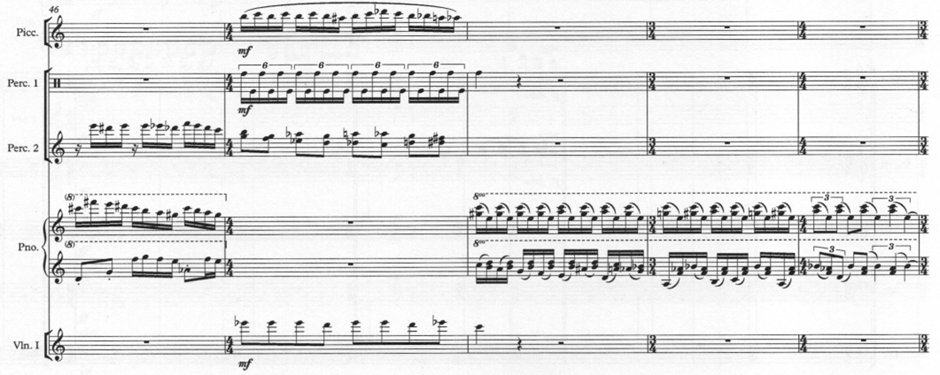
Bars 46–50 from Cresswell’s Piano Concerto No. 2. Adapted from “Trotz dem alten Drachen” (p. 1), Piano Concerto No. 2, 2017, SOUNZ. Copyright 2017 by the estate of Lyell Cresswell.
Piano Concerto No. 3: Cresswell did not live to witness this work being performed, having passed away peacefully in Edinburgh before the premiere. The quiet unison line of Cresswell’s third concerto actually picks up where the ending of the second concerto left off (Figure 51). It’s also intriguing to see that his third piano concerto contains five movements, the second concerto has six, and the first concerto with seven. These observations suggest that the composer might have conceived these works as a tryptych under the general themes of (1) Mortality, (2) Spiritual awakening, and (3) Transcendence of earthly form. Scored on a much smaller scale (piccolo, flute, cor anglais, 3 clarinets, 2 trumpets, percussion and strings), Cresswell knew this was going to be his last work and dedicated it to Stephen De Pledge as a final gift.
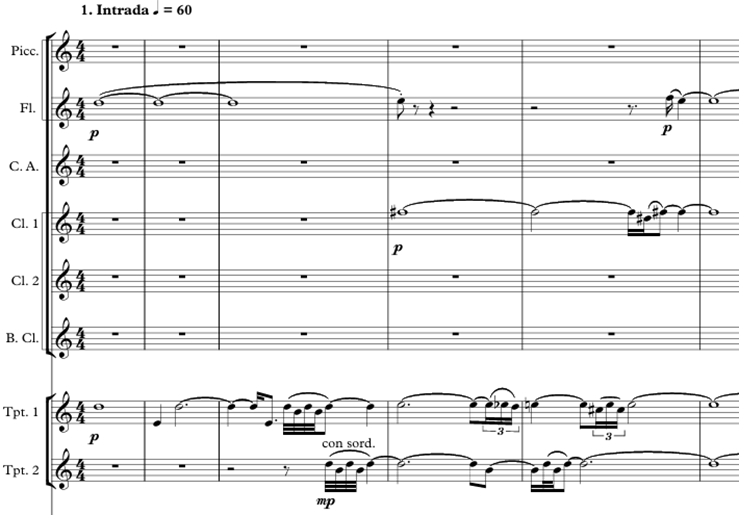
The muted beginning of Cresswell’s final piano concerto. Adapted from “Intrada” (p. 1), Piano Concerto No. 3, 2022, [Unpublished]. Copyright 2022 by the estate of Lyell Cresswell.
Chris Watson’s sings songs self (for Piano and Orchestra)
Like Cresswell’s first piano concerto, this work also received New Zealand’s highest honour for composition: the SOUNZ Contemporary Award 2015. It hadn’t been performed live, though it has received a finely crafted, virtuosic recording by Sarah Watkins and the New Zealand Symphony Orchestra. As with Gareth Farr and Leonie Holmes, Watson felt an intrinsic urge to write a piano concerto (RNZ 2014). His style of writing is highly intricate and rhythmically complex.
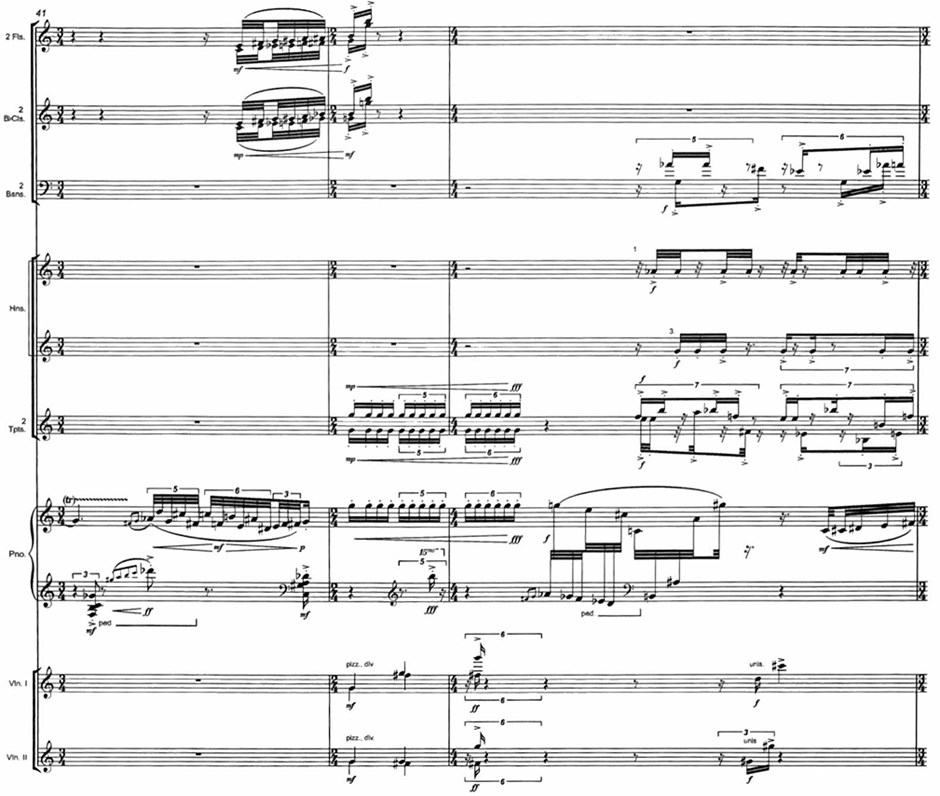
Bars 41–43 from ‘sing song self’. From sing song self (p. 8), 2012, [Unpublished]. Copyright 2012 by Chris Watson.
Gareth Farr’s Concerto for Piano and Orchestra
A brooding work which Farr noted was not delivered in his more usual style; he had also put a lot of thought and effort into this work and believed that it was a work of high quality and important personal meaning (Upbeat, 2014). Its backstory is similar to Cresswell’s in the way that the composer was self-motivated to compose a piano concerto, and it was not until Jack C. Richards provided the funding that the project could be realised. Curiously, it seemed like Farr used a setting of his own name as the main theme of this work, as observed in the following example:

The main theme from Farr’s Piano Concerto with my suggested setting.
Farr utilises appeggios and double octaves in his writing for piano in a way that Cresswell totally refrains from. There is a poignant passage which perhaps suggest an underlying seriousness nad spirituality.
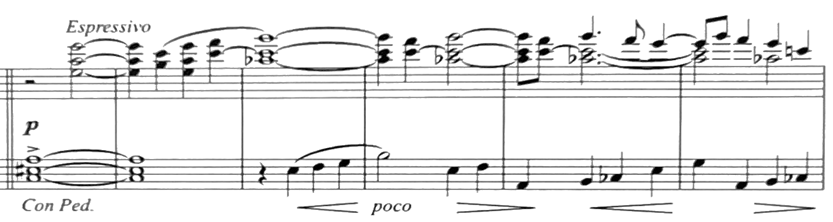
Bars 210–215, piano solo from Farr’s Piano Concerto
Karlo Margetić’s Piano Concerto ‘Melting Furniture’
The soloist/commissioner again was Michael Houstoun in this highly inventive work, which features quarter-tone elements – played by slide cello and electronic keyboard. Margetić names György Ligeti, Salvatore Sciarrino and Anton Webern as composers who have influenced him, and he is drawn to music that has a continuous, unrelenting quality (Music Alive, 2016). Melting Furniture sounds rather unorthodox, and its off-kilter soundworld which grows upon the listener after repeated listening.
Nick Hunter’s Piano Concerto
A very original work and pianistically conceived, this piece was premiered by the Manawatu Sinfonia, with the composer himself as the soloist. Hunter’s work, like Farr’s, pits the piano against the orchestra to create ‘battle’ and excitement. The structural integrity of the work is strong and we see a glimpse of Cresswellian 3-D granite chords in the following excerpts:
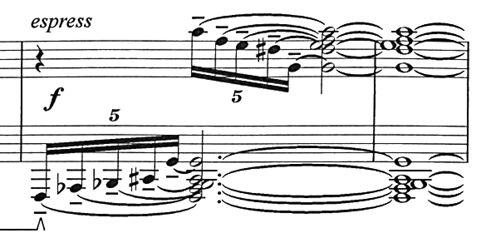
Bars 150–151 from Nick Hunter’s Piano Concerto
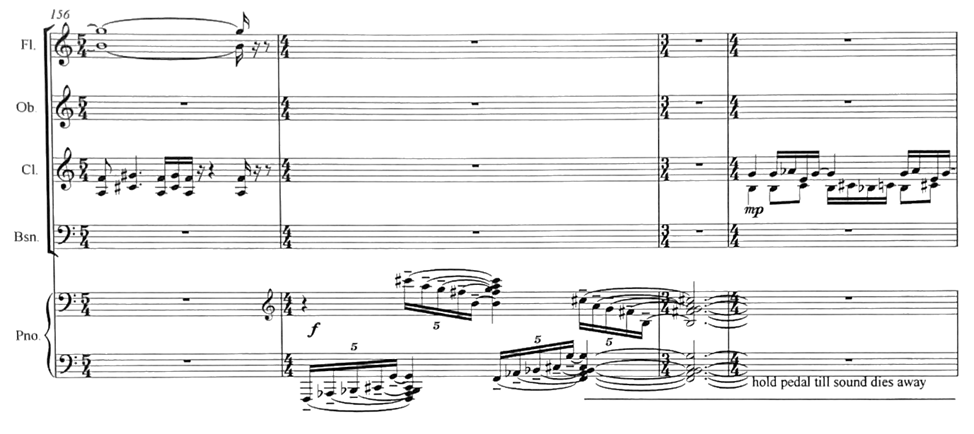
Bars 156–159 from Hunter’s Piano Concerto. From Piano Concerto (p. 42), 2022, SOUNZ. Copyright 2022 by Nick Hunter.
Leonie Holmes’ Piano Concerto
Holmes had been motivated for some time to write a piano concerto, and in 2019, the circumstances allowed her to begin work on one (Crump, 2023). A strong beginning is not a common feature amongst the composer’s orchestral works. A survey of some of her important orchestral compositions reveals that they commonly begin with (1) a unison line, (2) subdued dynamics and (3) thin orchestration, sometimes with a simple drone as accompaniment.
Examples include: Solstice, which begins with a gentle drone in the cellos, which provides a ‘ground’ for the lone melodic line in the cor anglais. Auque Sulis starts with a delicate solo by the wam-toned Alto Flute. Elegy starts softly with a drone in the harp, which accompanies an almost unison melody played by solo cellos. For just a little moment begins quietly with the brass spelling out the first chords while Frond begins quietly with a high drone in the strings as accompaniment to a solo violin playing the melody. Holmes herself also acknowledged that she tends to start with solos in her compositions (SOUNZ Centre for NZ Music, 2020).
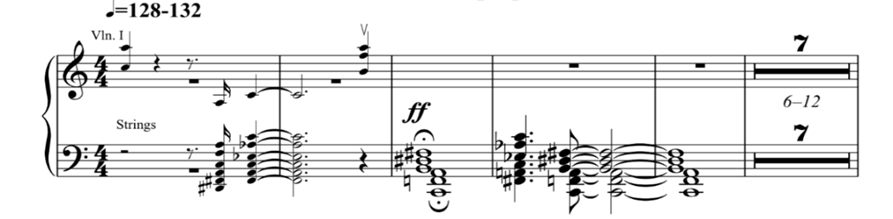
The opening of her magnificent Piano Concerto is especially striking in that it reminded me of ‘granite’ chords
Discussion
The unfortunate fact remains that most New Zealand piano concertos have not received repeat performances despite being one of the strongest bodies of works from this country – two of the 13 performed/recorded works have received the country’s highest award in composition, while others have been very well received by the audience and critics alike. However, perhaps due to financial restraints, orchestras in New Zealand tend not to programme or commission piano concertos from their own composers. Out of the 15 works from the current century, four were written out of intrinsic motivation (unpaid), while seven were commissioned by the soloist or private entities.
So what are some practical steps that researchers can take to encourage the (re)performance of New Zealand piano concertos? Historically, undertakings by composers such as Vincenz Lachner involved him in producing arrangements of the five Beethoven piano concertos for piano, violins, viola, cello and double bass. His intention was to make these large-scale pieces accessible for a small ensemble, as live orchestral concerts were relatively rare compared to chamber music performances. Beethoven himself approved of a piano trio arrangement of his Second Symphony, for the same reason.
Recently, Shai Wosner’s piano trio arrangements of Beethoven’s Symphonies have been performed and recorded, receiving positive feedback from the public. There has also been recent research published by Nathan James Arch titled Konchakovna’s Cavatina from Aleksandr Borodin’s Prince Igor: A Transcription & Arrangement for Piano Trio. Furthermore, NZTrio co-founder Sarah Watkins agrees that NZTrio’s past performances of orchestral transcriptions have been quite effective in concert (S. Watkins, personal communication, October 3, 2025).
In my opinion, NZTrio is the ideal ensemble to present arrangements of New Zealand piano concertos. They continue to demonstrate their commitment to contemporary New Zealand music, recently participating in a 2+ hour composition workshop where they workshopped eight new student compositions. Their recent season (2025) actually features transcriptions of orchestral works[6]. Furthermore, Bathurst & Williams (2014) recognised the following defining characteristics of this award-winning group (1) Their ability to form communities, (2 ) Their ability to create collaborative partnerships beyond their own organisation and (3) They have reached into the audience to form a much wider community of NZTrio followers
What the piano trio lacks in uniformity of sound and portability, compared to, say, a string quartet, it makes up for in terms of volume and instrumental range. What it lacks in fullness of sound of a quintet or sextet, it makes up for in reduced production and logistics costs. Extended investigation and workshopping of arrangements, however, will be necessary to maximise the various sonorities and effects available. The prudent arranger must keep in mind that:
“The essential problem in writing music for strings or winds with piano is immediately apparent: the sonorities do not readily mix. Stringed… instruments naturally produce sustained sounds, whereas a piano note decays from the moment it is struck… Hence, the expressive possibilities of the instruments are different and often contradictory; and as increases in virtuosity made their capabilities more specific, these differences become more pronounced” (Kaplan, 2000, p. 127).
In writing about Ravel’s Piano Trio, Dowling (1990) detected that the composer was well aware “…of the disparate sonorities of piano and strings…” and that Ravel “…often achieves balance between the piano and strings by putting the treble part of the piano line between the string parts, which are spaced two octaves apart.”
As a performer and creative practitioner based in New Zealand, I am personally committed to promoting musical works by New Zealanders. While academic studies have been conducted on New Zealand orchestral and solo piano compositions by Glenda Keam (2006), Lee Martelli (1995) and Joohae Kim (2012), piano concertos have not received such attention. The aim of this research is to create interest and spur performers and concert organisers to present these works live, thereby keeping the contemporary piano concerto practice alive in New Zealand.
List of References
Bathurst, R., & Williams, L. (2014). Music Beyond the Chamber: NZTrio and Embodied Communities. In The Physicality of Leadership: Gesture, Entanglement, Taboo, Possibilities (Vol. 6, pp. 135–152). Emerald Group Publishing Limited. https://doi.org/10.1108/S1479-357120140000006006
Coroiu, P.-M. (2022). A perspective on the concerto genre in the 20th century. Bulletin of the Transilvania University of Braşov. Series VIII: Performing Arts, 14(63) (Special Issue), 49–56. https://doi.org/10.31926/but.pa.2021.14.63.3.5
Crump, B. (2023, October 12). Leonie Holmes and the blessings of procrastination [Radio broadcast]. RNZ. https://www.rnz.co.nz/concert/programmes/three-to-seven/audio/2018910870/leonie-holmes-and-the-blessings-of-procrastination/
DeNora, T. (2005). The concerto and society. In S. P. Keefe (Ed.), The Cambridge Companion to the Concerto (pp. 19–32). Cambridge University Press.
Dowling, R. (1990). Preface to Dowling Urtext Edition of Ravel’s Trio for Piano, Violin and Cello. https://www.richard-dowling.com/RavelTrio.html#ftnref28
Keam, G. (2006). Exploring notions of National Style: New Zealand orchestral music in the late Twentieth century [Doctoral dissertation, University of Auckland]. University of Auckland Research Repository – ResearchSpace. https://hdl.handle.net/2292/56
Keefe, S. P. (2005). Theories of the concerto from the eighteenth century to the present day. In S. P. Keefe (Ed.), The Cambridge Companion to the Concerto (pp. 5–18). Cambridge University Press. https://doi.org/10.1017/CCOL9780521834834
Kim, J. (2012). Contemporary New Zealand Piano Music: Four Selected Works from Twelve Landscape Preludes: Landscape Prelude, the Street Where I Live, Sleeper and the Horizon from Owhiro Bay [DMA dissertation, Florida State University]. Florida State University Libraries. https://docslib.org/doc/4759487/contemporary-new-zealand-piano-music
Martelli, L. (1993). Solo piano music in New Zealand in the 1960s [Master’s thesis]. University of Auckland.
RNZ. (2014, November 5). Chris Watson. RNZ. https://www.rnz.co.nz/concert/programmes/appointment/audio/20155926/chris-watson
SOUNZ Centre for NZ Music. (2020, April 18). LEONIE HOLMES: Baby Boomer Composer Interview. YouTube. https://www.youtube.com/watch?v=BqeZcRi2MLU
Upbeat (2014, March 25). Gareth Farr: NZ Composer [Radio broadcast]. RNZ. https://www.rnz.co.nz/concert/programmes/upbeat/audio/2590186/gareth-farr-nz-composer
Wilson, C. (2014, October 14). Composer of the Week: Lyell Cresswell (b. 1944) [Radio broadcast]. RNZ. https://www.rnz.co.nz/concert/programmes/composeroftheweek/audio/20152659/lyell-cresswell-b-1944
Table of New Zealand Piano Concertos
| Year | Composition | Composer | Notes |
| 2024 | Piano Concerto No. 3 | Lyell Cresswell | Meditative, intimate |
| 2023 | |||
| 2022 | Piano Concerto | Leonie Holmes | Propulsive, Dramatic |
| 2022 | Piano Concerto | Nick Hunter | Stringent |
| 2021 | |||
| 2020 | |||
| 2019 | |||
| 2018 | |||
| 2017 | Piano Concerto No. 2 | Lyell Cresswell | Still, Fragmentary |
| 2016 | |||
| 2015 | Melting Furniture | Karlo Margetić | Quartertones, Off-kilter |
| 2014 | Piano Concerto | Gareth Farr | Brooding |
| 2014 | |||
| 2013 | |||
| 2012 | sing songs self | Chris Watson | Glistening, Evocative SOUNZ Award Winner |
| 2011 | |||
| 2010 | Piano Concerto No. 1 | Lyell Cresswell | Monolithe, Serious SOUNZ Award Winner |
| 2009 | Rock Concerto | Jenny McLeod | Entertaining, Nostalgic |
| 2008 | Piano Concerto No. 3 | Anthony Ritchie | Sunny, Life-affirming |
| 2007 | Piano Concerto | Gao Ping | Ancient |
| 2006 | |||
| 2005 | Piano Concerto | David Hamilton | Easy going |
| 2004 | Piano Concerto | Kenneth Young | Whimsical, Melancholy |
| 2003 | Three Psalms | John Psathas | Energetic, Post-minimalism |
| 2002 | |||
| 2001 | Concerto Balabile | Edwin Carr | Influenced by ragtime, foxtrots, waltzes, etc |
| 2000 | |||
| 1999 | |||
| 1998 | |||
| 1997 | |||
| 1996 | |||
| 1995 | |||
| 1994 | |||
| 1993 | |||
| 1992 | |||
| 1991 | |||
| 1990 | |||
| 1989 | Piano Concerto | Gareth Farr | (No Recording) |
| 1989 | |||
| 1988 | Poems for piano and orchestra | Edwin Carr | (No Recording) |
| 1987 | The Coming of Tane Mahuta | Christopher Blake | (No Recording) |
| 1987 | Peregrinations | Eve de Castro-Robinson | (No Recording) |
| 1986 | Piano Concerto No. 2 | Edwin Carr | Muscular |
| 1985 | |||
| 1985 | Autumn Concerto | Anthony Ritchie | (No Recording) |
| 1984 | |||
| 1983 | |||
| 1982 | Piano Concerto No. 1 | Anthony Ritchie | (No Recording) |
| 1981 | |||
| 1980 | |||
| 1979 | |||
| 1978 | |||
| 1977 | Piano Concerto | Christopher Norton | (No Recording) |
| 1976 | |||
| 1975 | |||
| 1974 | |||
| 1973 | |||
| 1972 | |||
| 1971 | |||
| 1970 | |||
| 1969 | |||
| 1968 | |||
| 1967 | |||
| 1966 | |||
| 1965 | |||
| 1964 | |||
| 1963 | Piano Concerto | Philip Hodgson | (No Recording) |
| 1962 | Piano Concerto No. 1 | Edwin Carr | (No Recording) |
| 1961 | |||
| 1960 | |||
| 1959 | |||
| 1958 | Concerto for Piano and Strings | Rod Biss | (No Recording) |
| 1944 | Concerto in F minor | Henry Shirley | (No Recording) |
