Lyell Richard Cresswell’s Piano Concerto No. 1 is New Zealand’s most recognised and successful concerto for piano and orchestra, and is one of, if not the Nation’s greatest concertante work. It was completed in 2009 and premiered in both New Zealand and Scotland in 2011. It is a large-scale composition that received a video recording with pianist Stephen De Pledge and the Christchurch Symphony Orchestra, an audio recording with De Pledge and the New Zealand Symphony Orchestra, print publications by both SOUNZ and the Wai-te-ata Music Press, as well as the 2011 SOUNZ Contemporary Award. It is New Zealand’s most successful piano concerto to date.
Significant works of art rarely, if ever, just appear out of the blue. Musicologists tasked with investigating great musical compositions use various methods to throw light on the origins and progression toward the final product. For example, the magnificent last movement from Mozart’s final Symphony contains a theme that can be traced back to his very first symphony, which in turn can be traced back to an old plainchant. My investigation will employ a qualitative, critical approach and is grounded in the belief that, to quote Judy Lochhead, what we “…write or say about music, how [we] graphically depict music’s sounding, or how [we] physically embody musical sound… affect how people experience music” (Lochhead, 2016, p. 3).
Cresswell’s work was commissioned by New Zealand linguist and philanthropist Jack C. Richards for Stephen De Pledge. De Pledge is an internationally recognised performer who has commissioned, performed, recorded and published over a hundred contemporary compositions. He first encountered Cresswell’s music as a 15-year-old violist in the National Youth Orchestra and was “…completely blown away…” (Radich, 2011) by the soundworld created by the composer. De Pledge described the experience of performing Cresswell’s first piano concerto as “…quite simply one of [his] favourite music experiences ever” (Cresswell, Whitehead & Askew, 2024, p. 226) and considers it to be New Zealand’s greatest piano concerto (Kerr, 2022).
Cresswell dedicated Piano Concerto No. 1 to the English composer and conductor Edward Harper, whose death on Easter Sunday, 2009, affected him deeply. Harper had been very supportive during the early stages of Cresswell’s career and would eventually become like a brother to him (Wilson, 2014). During the acceptance of his laureate award in 2016, Cresswell stated that “[w]hen I write music, I am writing my autobiography. If I were to use words, I would tell a pack of lies, but when I write music, I find it impossible to lie…” (Kerr, 2022). He added that “…in a strange way the whole concerto was written under the shadow of [Harper’s death],” but goes on to clarify that the work is “…also a celebration of Edward’s life as much as anything…” (Tulmelty, 2012).
Prior to the first piano concerto, Cresswell had written a number of orchestral works and concertos for accordion, string quartet and trombone, among others. He wrote a small number of solo piano works, most significantly, a suite of pieces[1] inspired by the painting and artistic techniques (the composer himself was excellent at drawing and painting). In these piano ‘studies’, he developed a way of writing which would be expanded in his first piano concerto.
Piano Concerto No. 1 is scored for solo piano and a large orchestra consisting of Woodwinds 3,3,3,3 | Brass 4,3,3,1 | Timpani | 3 Percussionists | Harp | Strings. There are seven movements, which are played without a break and last approximately 30 minutes in performance. The inner movements, numbers 3, 4, 5 and 6 were written before Harper’s passing, during the last months of his life, when he was ill with terminal cancer.
Seven is a significant number in Christianity, and it is worth mentioning another significant seven-movement work by Cresswell, The Voice Within. This work,composed about a decade earlier, is also a concerto (for violin, soprano, and orchestra) and incorporates written text that speaks about personal emotions. The composer follows a similar format in his first piano concerto: both pieces start evocatively, conclude with a virtuosic final movement and sandwiched in between, are two scherzos as well as more contemplative movements which function as contrasting interludes.
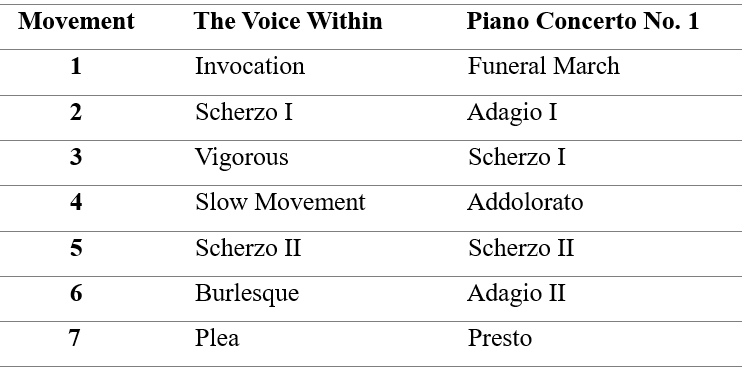
Structural comparison between The Voice Within and Piano Concerto No. 1
The choice to write a piano concerto for a deceased friend may seem unlikely, given the genre’s nature. From its inception to the present day, Keefe (2005) observed that the concerto form, in broadest terms, provides “…a vehicle for the solo performer(s) to demonstrate their technical and musical proficiency; in practical terms, concertos demonstrate multifarious types of solo–orchestra interaction and virtuosity…” (p. 7). Furthermore, Schneider (2005) observed that concertos for solo string instruments are more likely to deal with the subject of death (and transfiguration).
However, some five years prior, there was a premiere of another piano concerto by New Zealand composer Kenneth Young, whose mother was also dying from cancer during the writing of the piece. Young poignantly reflected that the second movement “…expresses what [he] felt at the time” (Young, 2014). His mother passed away a day after the premiere of the concerto.
Jenny McLeod’s Rock Concerto was completed in 2009 – approximately the same time Cresswell was working on his concerto. The second, slow movement, titled ‘Elegy for Charlie French’ was written in memory of her close friend who had died of AIDS. Cresswell was well-connected with New Zealand musicians (S. De Pledge, personal communication, September 19, 2025) and always tried to return home when he could (Wilson, 2014), so it is likely he would’ve been aware of these works.
Considering the circumstances in which the first piano concerto was created, I propose a connection with the well-known psychological phenomenon known as the ‘Seven Stages of Grief” as seen in the following table. This is speculation on my part, of course, but I believe it is appropriate and can offer an interesting angle to view the overview structure and progression of the various sections.
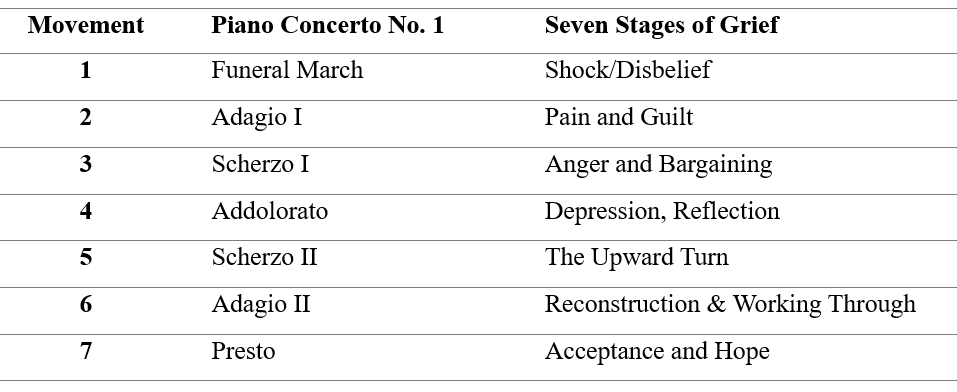
Comparison between movements and the Seven Stages of Grief
Movement One: Funeral March
Cresswell grew up with a father and uncle who were both bandmasters and four grandparents who were officers in the Salvation Army. As a result, he developed an enduring love of brass band music (Shaw, 2000) and admitted that this sound world influenced him as a mature composer (Wilson, 2014). The first movement of the concerto begins with sombre, clustered chords in the murky range of the piano and orchestra – a soundscape that was perhaps influenced by both the thick sounds of the brass bands and partly by the dramatic, fog-laden landscapes of Scotland, where the composer lived while he was working on this piece. Personally, I had experience playing in a Salvation Army Brass Band and can attest to the timbres the composer would have been familiar with growing up.
Just a few years prior to the composition of his first piano concerto, Cresswell was commissioned by De Pledge to compose a ‘Landscape Prelude’, and the resultant work was entitled Chiaroscuro. Chiaroscuro is a visual art method that the composer describes as “…light and shadow to create the illusion of three-dimensional objects” (Holloway et al., 2011, p. 20). The following excerpt shows the soft chords that begin this piece. These chords perhaps represent the ‘shadow’ and are a fine example of the composer’s multi-dimensional creative practice, where visual arts (as well as poetry) carried over to his musical sensibility.
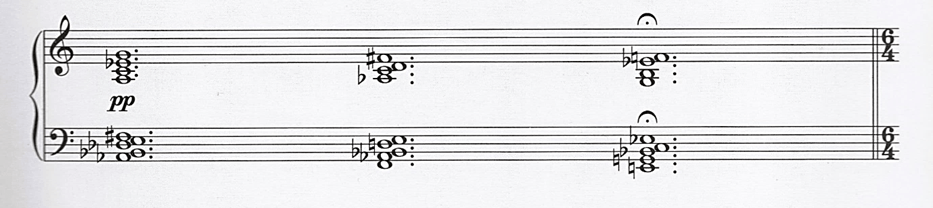
Beginning of Chiaroscuro. Adapted from“Chiaroscuro”(p. 21), Landscape Preludes, 2011, Score. Copyright 2005 by the estate of Lyell Cresswell.
The chords at the beginning of the first movement of the piano concerto extend upon this idea by incorporating appeggiation. Cresswell ingeniously renders the harmony a three-dimensional quality, lifting the sound out of the silence that a block chord could not achieve.
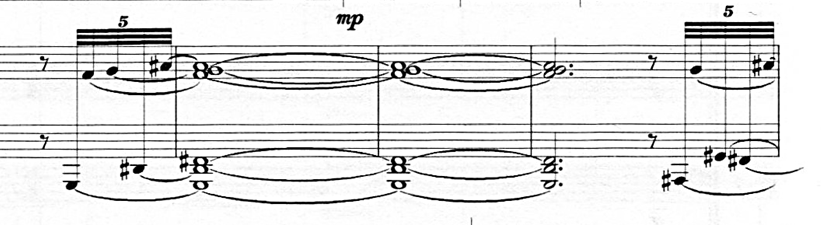
Bars 78–81 from the 1st movement, piano part, bass clef. Adapted from “Funeral March” (p. 11), Concerto for Piano and Orchestra, 2010, SOUNZ. Copyright 2010 by the estate of Lyell Cresswell.
These ‘3-D chords’ in the piano serve as a kind of gong that paints a sound picture of a funeral procession, and the composer enhanced this special effect by initially extending the piano’s limited resonating capabilities with 6 string players and later with low woodwinds, perfectly dovetailing the piano’s fading reverberation (see below). This was what Cresswell was referring to when he explained that “[t]he orchestra becomes an extension of the piano, sustaining these chords and taking them where the piano can’t go” (Tumelty, 2012). De Pledge concurs, describing that “[t]he piano feels like a gigantic sound box, from which emerge resonances and extensions throughout the orchestra…” (Kerr, 2022).
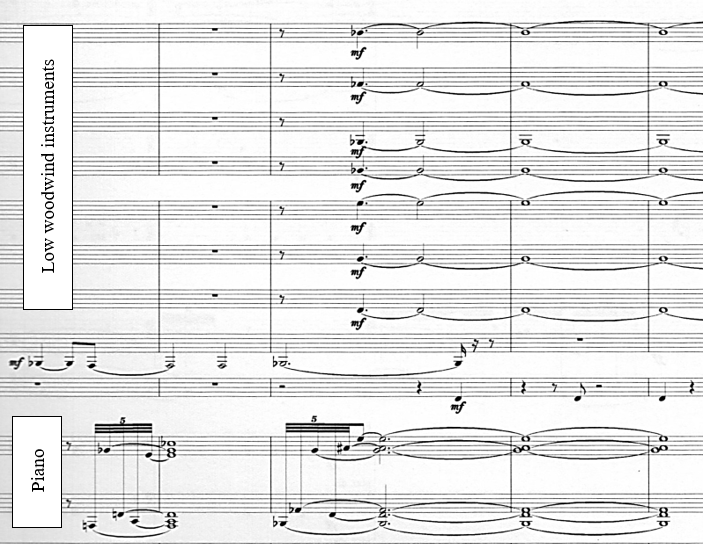
Bars 82–86 from the 1st movement, bass clef. Adapted from “Funeral March” (p. 11), Concerto for Piano and Orchestra, 2010, SOUNZ. Copyright 2010 by the estate of Lyell Cresswell.
This sombre soundworld can be traced back to 1980, thirty years prior, whenCresswell wrote a song entitled Funeral Hymn. This was a setting of a nineteenth-century Shaker text, which begins: “Our brother’s gone, he is no more”. Other phrases, such as ‘mortal clay’, refer to the temporary nature of the human body, while ‘burst the bonds’ is a metaphor for overcoming or transcending the limitations of the physical form. In the following illustration, we see this early version of the funereal atmosphere, which was later expanded upon at the beginning of the piano concerto.
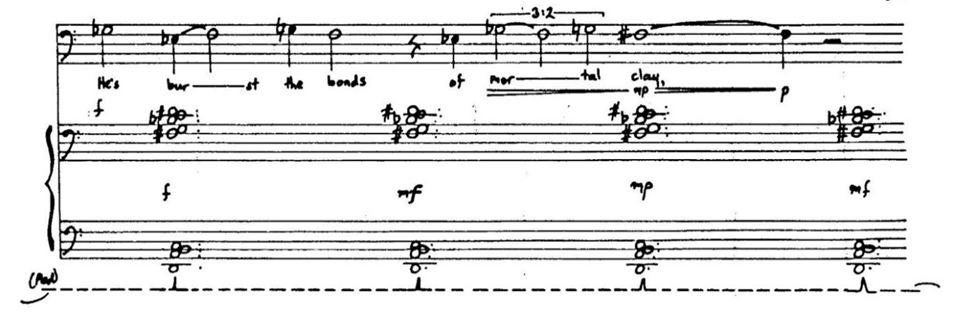
Fourth system from Funeral Hymn. Adapted from“Funeral Hymn”, by Lyell Cresswell, Seven Shaker songs, (p. 9), n.d. Lyell Cresswell. Copyright n.d. by the estate of Lyell Cresswell.
Despite very little in the way of commentary by Cresswell himself on his Piano Concerto No. 1, he did state that the first three “…chords provide the basis for the complete concerto and are treated in various contrasting ways in each movement” (Cresswell, 2012). Upon closer examination, we see that the composer possibly had his late friend’s name in mind when he committed these chords to paper. This is a resemblance not unlike the beginning of Beethoven’s Piano Sonata Op. 106, in which commentators such as Cooper (2008) noted a similarity between its main motif and the dedicatee’s name.
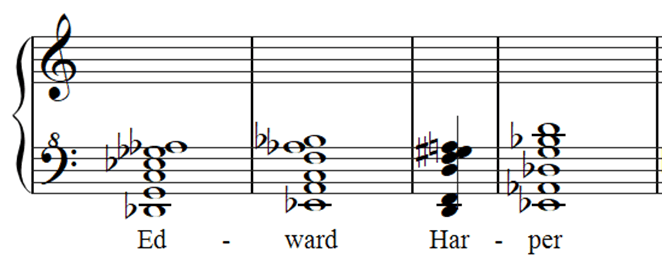
Opening chords of the concerto, with my setting of Edward Harper’s name.
Throughout this opening movement, a throbbing pulse governs the music. These painful pulsations perhaps align with the first stage of grief, where one feels numbness and disconnect toward their emotion. They first appear low in the harp (a subtle, yet powerful sonic illusion), then sometimes the timpani, and other times in pizzicato strings. The murky orchestration here creates a sense of suppressed sadness as one starts to ponder the finality of life. In his compositions, Cresswell often adopts quite a systematic and academic procedure – perhaps it was his way of taming his vast creative energies. When writing music, he actually enjoyed using various pencils, pens, and various other tools from the visual arts (Wilson, 2018), His doodlings were actually eventually published as a collection of graphic scores. He was disciplined but also knew how to amuse himself and free up the creative process. The composer conceded that making plans and calculations can be fun to do and perhaps even a form of procrastination, but confirms that “…once the rules are established the hard work begins” (Cresswell, Whitehead & Askew, 2024, p. 126).
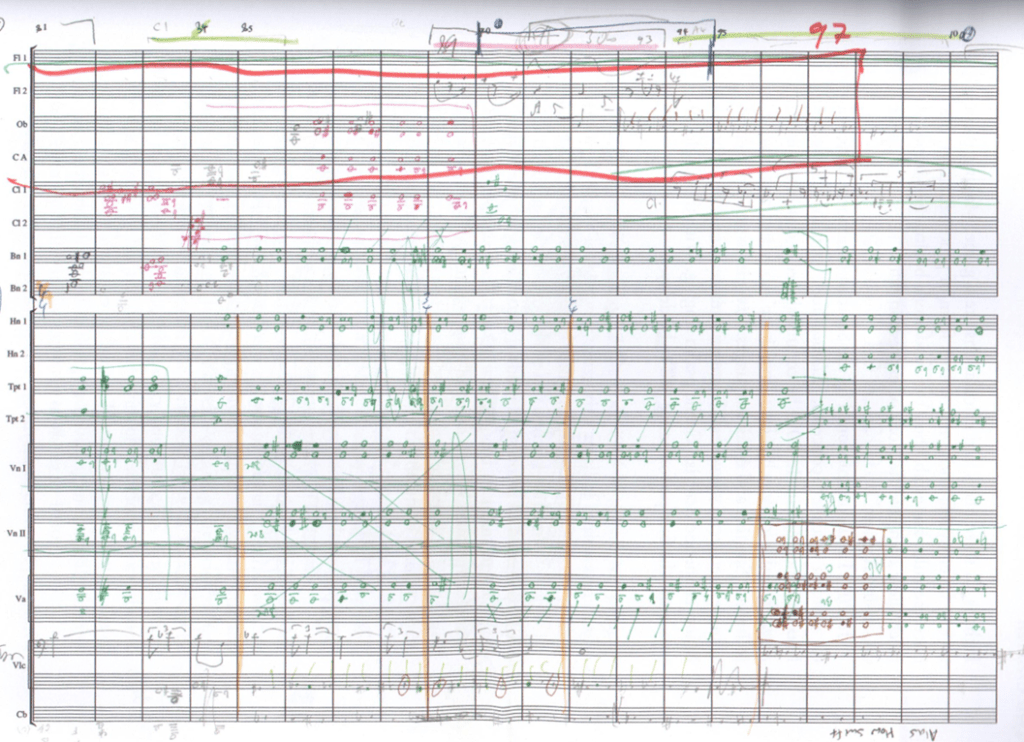
Example of Cresswell’s harmonic planning for his composition ‘Alas! How Swift’. From Divagations, Doodlings, and Downright Lies (p. 125), 2024, Te Herenga Waka University Press. Copyright 2024 by the estate of Lyell Cresswell.
In the illustration below, we observe that the form of the first movement can be accommodated within the framework of a small-scale sonata form. Bars 1–37 represent the main subject and transition to the ‘secondary’ subject at bar 38, labelled as interlude 1. Militaristic dotted rhythms intensify the volume and rhythmic drive of the music, which peaks in bar 72 before the energy dissipates and the sombre funereal atmosphere reappears, as the recapitulation, in bar 75.
Two interludes, which we could consider as secondary subjects, are scored in the high register and provide a relief to the ear from the heavy, low timbres. The voice-leading among the six lines is impeccable, demonstrating the composer’s mastery of the fundamentals of composition. Cresswell also employs quartal harmonies — a favoured trope among twentieth and twenty-first-century composers, in order to create a rather modern, yet ancient/medieval sound. (Singing lines a fourth apart was a common feature in music from the Middle Ages).
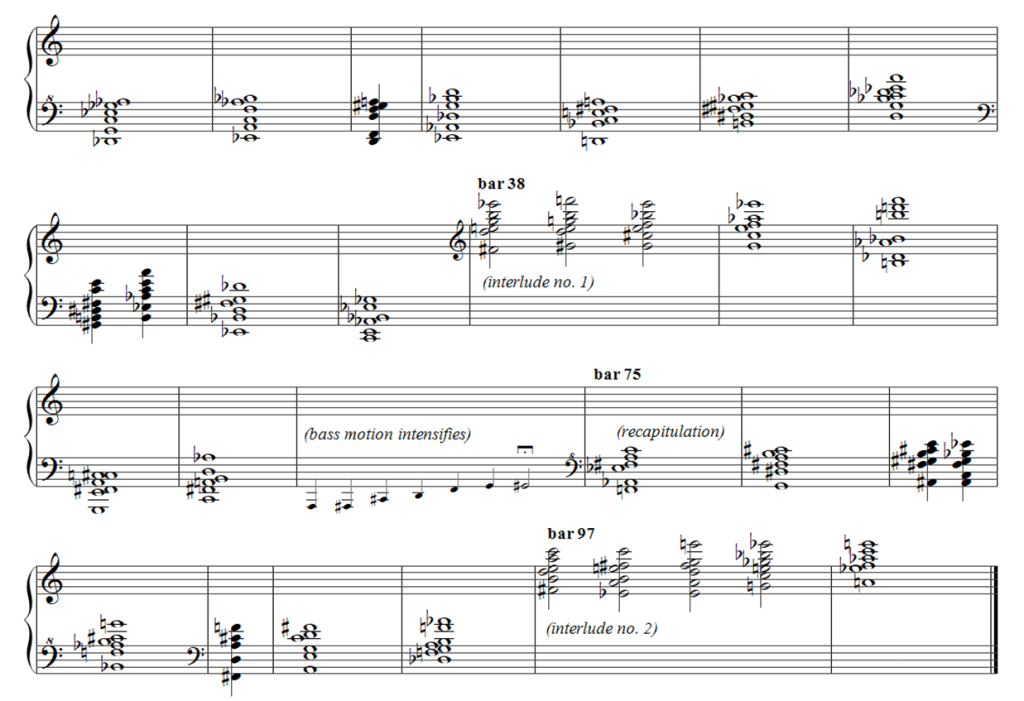
Reduction of the harmonic plan of the 1st movement. Watch Here:
Movement Two: Adagio I
The glockenspiel starts this movement with a melody, derived from the Edward Harper (E. H.) motif. Normally in an orchestral context, the glockenspiel is effectively used to double flutes, oboes, clarinet or harp (Alexander & Melillo, 2009); however, Cresswell scores it as a solo lead, accompanied by high, almost inaudible string harmonics. On the surface level, the mood here is tranquil, but the sorrow lying underneath is palpable. This movement can be considered an extension of the first in terms of temporal stillness; however, contrast to the prior movement is achieved by placing the musical material primarily in a high register. The instrumentation here, with ample high overtones, produces a rather unsettling and intense effect. We can relate this to the second stage of grief, where one feels intense sorrow and regret over things left undone. Evidently, the melody in the piano in bar 32 is a slightly modified version of the E. H. motif, and in this version creates an ethereal, haunting sentiment.
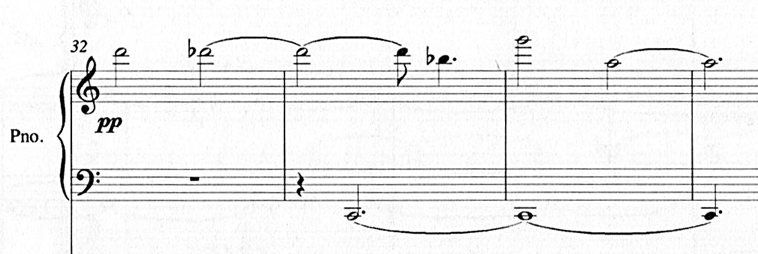
Bars 32–35 from the 2nd movement. Adapted from “Adagio I” (p. 15), Concerto for Piano and Orchestra, 2010, SOUNZ. Copyright 2010 by the estate of Lyell Cresswell.
In bar 75, the music comes to a relative rest (I have termed it the ‘repose chord’) where the low woodwinds and muted trombones deliver an unexpected sonority for the listener. Bars 78–81 represent the only time we hear arco strings in this movement. Played by just 6 players, the music subtly dovetails from the timbre of the woodwinds, this chord provides a moment of warmth amid the cold reality of death:
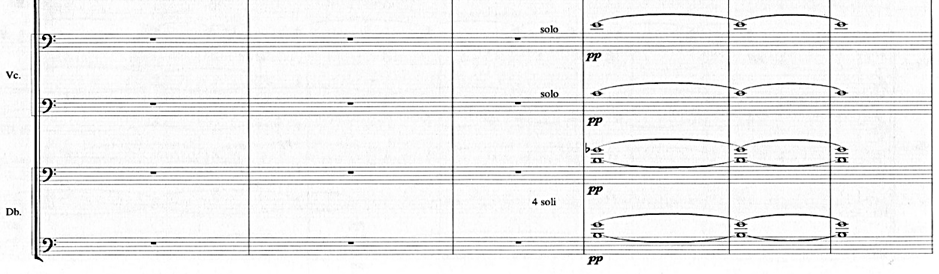
Bars 75–81 from the 2nd movement. Adapted from “Adagio I” (p. 18), Concerto for Piano and Orchestra, 2010, SOUNZ. Copyright 2010 by the estate of Lyell Cresswell.
Structurally, Cresswell’s second movement is reminiscent of Charles Ives’ Unanswered Question, a piece where the soloist also poses (unanswered) questions against the backdrop of sustained strings and interjecting woodwinds:
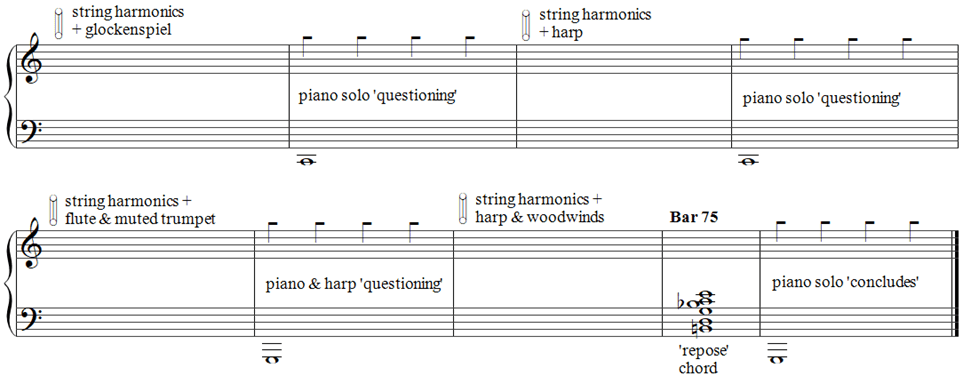
Structural map of the 2nd movement
Schneider (2005) noted that “while the dynamic range and textural variety of the piano make it a nearly ideal match for the orchestra, as a percussion instrument, the piano is limited by its inability to play a truly seamless legato, a liability that becomes more noticeable the slower the tempo, higher the range, or softer the dynamic” (p. 144). The following is an excerpt in Adagio tempo, which contains a variation on the E. H. motif played by the piano. Here, the composer pushes the concert grand to its absolute acoustic limits.

Bars 61–67 from the 2nd movement. Adapted from “Adagio I” (p. 17), Concerto for Piano and Orchestra, 2010, SOUNZ. Copyright 2010 by the estate of Lyell Cresswell.
Certainly, after this movement, where the pianist is commanded to do their utmost best to sustain slow, high, pianissimo notes, the composer seems to announce: ‘That’s it! Enough of that!’ At which point, after more than ten minutes of slow-moving material, movement three proceeds to burst right out of the gate.
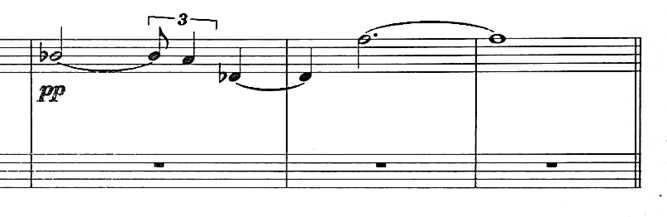
Final three bars of the 2nd movement, E. H. motif, piano, treble clef. Adapted from “Adagio I” (p. 19), Concerto for Piano and Orchestra, 2010, SOUNZ. Copyright 2010 by the estate of Lyell Cresswell.
Movement Three: Scherzo I
In discussing piano concertos, Schneider (2005) affirmed that “…the grander the initial orchestral utterance, the more difficult it is for the solo to find a response equal to the task” (p. 141). Cresswell seemed to have internalised this concept after years of composing and expertly refrains from showing all his cards at the outset. Instead, he stretches the audience’s attention span to its maximum threshold before opening the floodgates, so to speak. In contrast to the first two more meditative movements, the third movement was written before Harper’s death and depicts a more agitated state of mind.
Cresswell’s mother, a piano teacher, taught her son the basics of the keyboard. Despite not being a proficient instrumentalist, he knew his way around the keyboard and always ensured that what he wrote was physically possible to play. One distinctive feature of the composer’s writing for solo piano is what I would term ‘granite chords’. These are dense, colossal-sounding chords, mostly played simultaneously by both hands, observable in the highlights from the following examples.
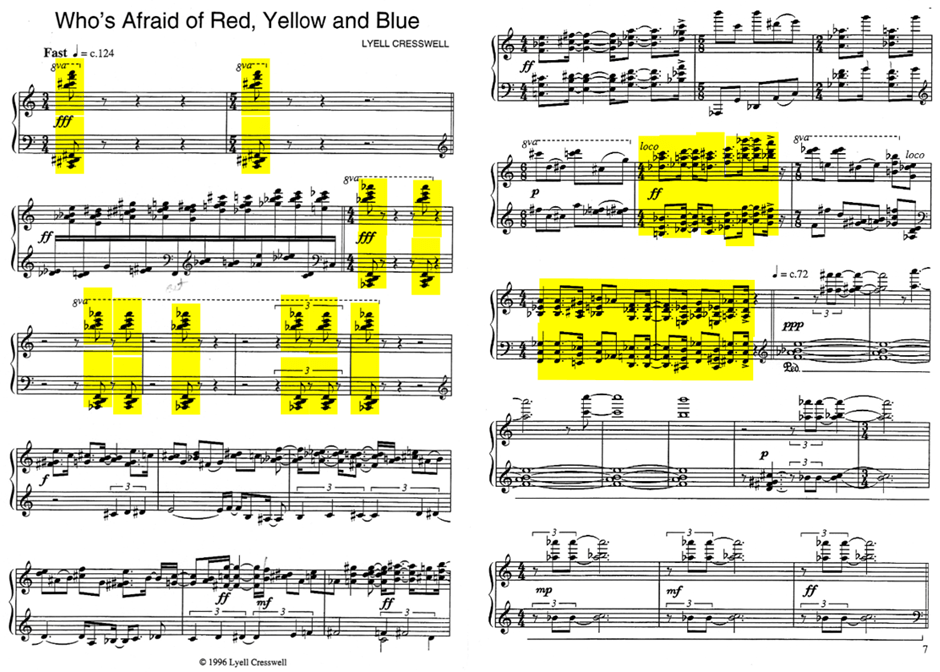
Adapted from Who’s Afraid of Red, Yellow (pp. 1 & 7), 1993, SOUNZ. Copyright 1996 by the estate of Lyell Cresswell.
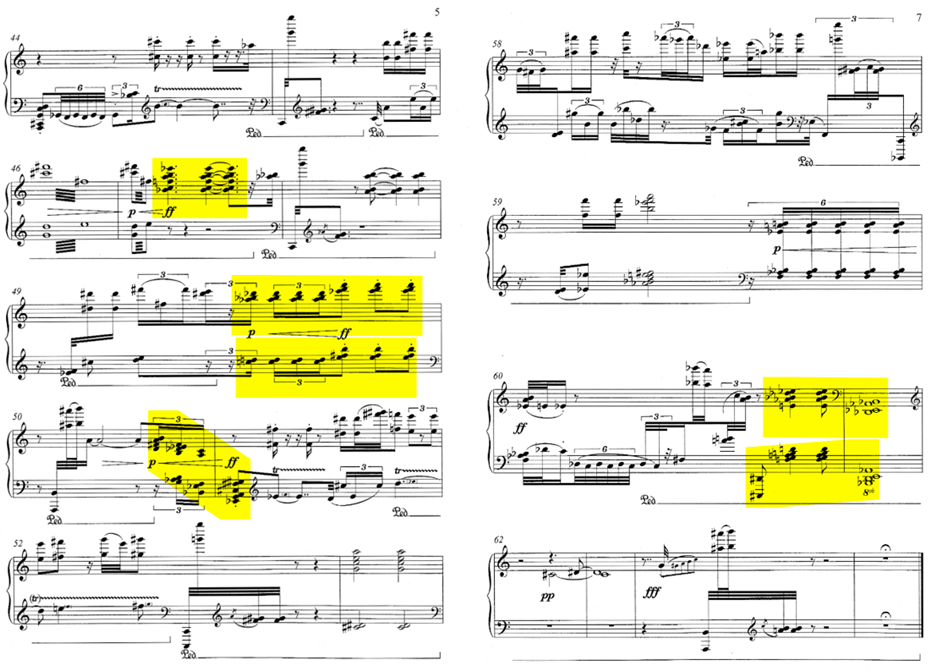
Impasto for solo piano. Adapted from Impasto (pp. 5 & 7), 2008, [Unpublished]. Copyright 2008 by the estate of Lyell Cresswell.
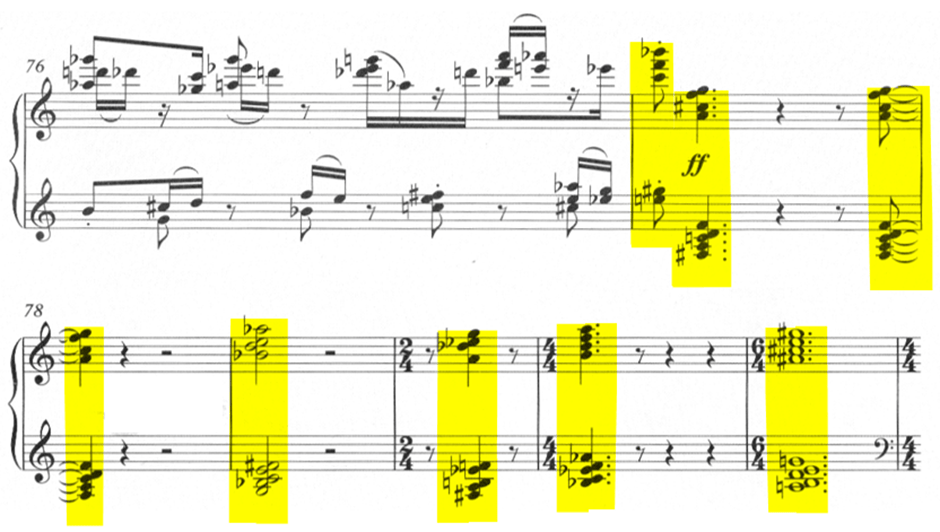
Bars 76–81 from Chiaroscuro for solo piano. Adapted from “Chiaroscuro” (pp. 27–28), Landscape Preludes, 2011, Score. Copyright 2005 by the estate of Lyell Cresswell.
Granite chords receive an incredibly enhanced treatment in the third movement of the concerto as the pianist begins powerfully, martellato, in its most resonant range. These alternating granite chords provide maximum volume and as well as producing a ‘3-D’ effect for a live audience.

Bars 1–3 from the 3rd movement. Adapted from “Scherzo I” (p. 20), Concerto for Piano and Orchestra, 2010, SOUNZ. Copyright 2010 by the estate of Lyell Cresswell.
The orchestra interjects with colourful timbres such as the heavily sighing strings seen below, and other unexpected instruments such as the maraca to compete with the piano (which until now could be considered as more of an honorary member of the percussion section as opposed to a true soloist).
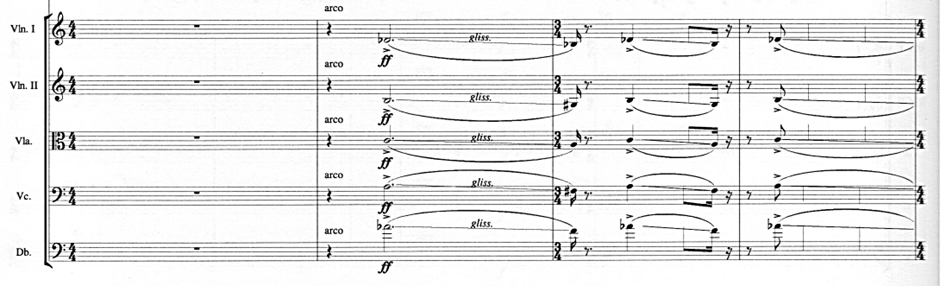
Bars 22–24 from the 3rd movement. Adapted from “Scherzo I” (p. 26), Concerto for Piano and Orchestra, 2010, SOUNZ. Copyright 2010 by the estate of Lyell Cresswell.
Whitall (2005) observed that “…the insatiable desire among concert audiences and record buyers for brilliant soloistic display must always be matched by the enthusiasm of individual virtuosos for new challenges” (p. 161). Cresswell certainly had in mind the enthusiasm and the powerhouse technique of Stephen De Pledge when he committed this passage to paper. This movement is over in just a couple of minutes, yet due to the lack of predictable patterns, the soloist put in a huge amount of effort just to get the notes under his fingers (S. De Pledge, personal communication, September 19, 2025).
De Pledge noted that nobody writes for the piano quite like Cresswell, and that one can almost instantly identify his style of writing just by looking at the score. Glenda Keam, in her reflection on Chiarosuro, observed sections where “…there is a playful interaction between the two hands, as if they are chasing or teasing each other across the piano” (Holloway et al., 2011, p. 120), and we can also find this theatrical, gestural style of writing in this scherzo movement:
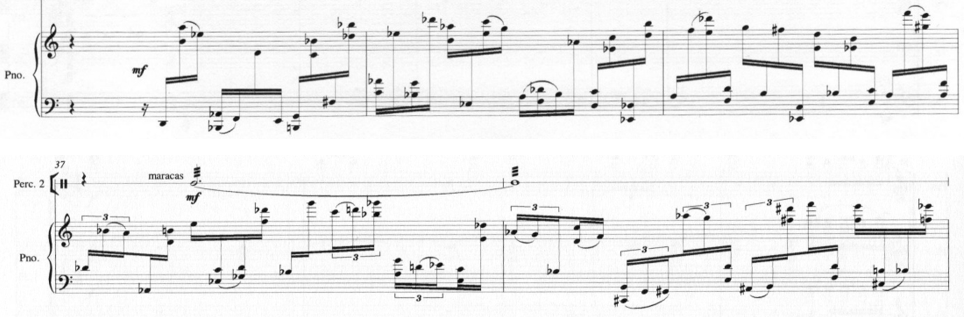
Bars 34–38 from the 3rd movement. Adapted from “Scherzo I” (p. 29), Concerto for Piano and Orchestra, 2010, SOUNZ. Copyright 2010 by the estate of Lyell Cresswell.
Chissell (1996) noted that the scherzo is “a movement traditionally conspicuous by its absence in concertos” (p.165), thus highlighting another peculiarity in the design of this concerto. It also aligns this concerto more with symphonic ideals, as suggested earlier. Cresswell stated that he has always “…been determined to keep [his] New Zealandness alive and never to lose that freshness, that characteristic New Zealand straightforward honesty” (Wilson, 2018). In the third stage of grief, there are strong emotions such as anger, frustration, and even bargaining with the higher power that incited the terrible event. The inclusion of a scherzo allowed the composer to channel the strong emotions he was feeling at the time of composition.
Movement Four: Addolorato
In writing about Brahms’ Piano Concerto No. 2, the first important example of a symphonic-concerto, Plantard (1997, as cited in Rakochi, 2021) observed that the composer “…seems to have challenged himself, overcoming the principle of repetition by using ‘symphonism’ as a mindset to embody in-depth transformation of the musical material” (p. 33). In Cresswell’s intensely emotional Addolorato, the composer transformed the E. H. motif to an incredibly concentrated level. The following illustration shoes how the movement begins with a vulnerable cry, featuring the E. H. motif in retrograde.
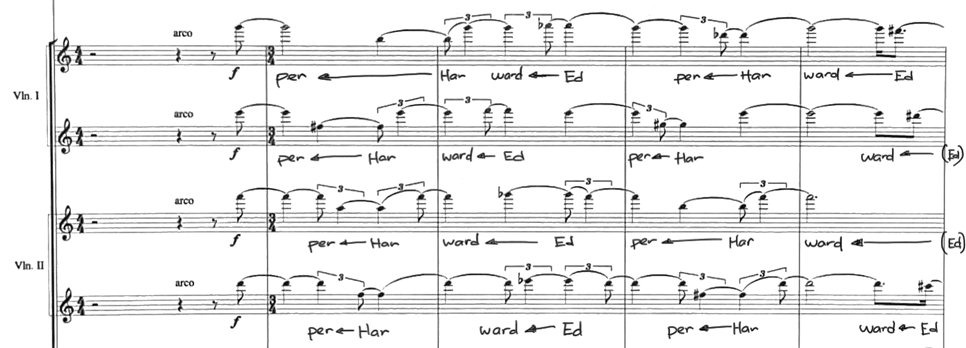
Bars 1–5 from the 4th movement with my annotations. Adapted from “Addolorato” (p. 39), Concerto for Piano and Orchestra, 2010, SOUNZ. Copyright 2010 by the estate of Lyell Cresswell.
In reference to the fourth stage of grief, this is where one experiences deep depression, and a profound sadness starts to sink in. Considering his entire oeuvre, Addolorato shows Cresswell in one of his most vulnerable states. The loud, wailing lines are reminiscent of Tchaikovsky’s painful sobs from his final masterpiece.
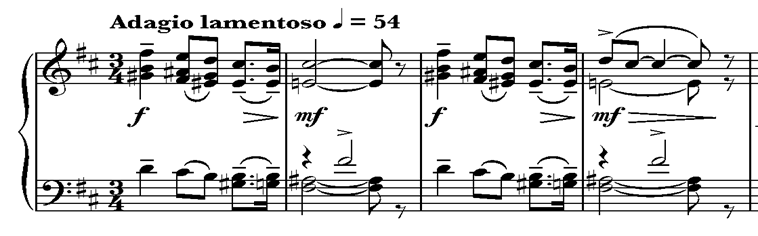
Bars 1–4 from the 4th movement of Tchaikovsky’s last Symphony. Adapted from “Adagio Lamentoso”, Symphony No. 6, Op. 74, 1893, Pyotr Ilyich Tchaikovsky. In the public domain.
Fugal writing is another highly unlikely feature to find in a piano concerto. Composers generally write fugues not for public display but to (1) honour the greatest master of counterpoint, J. S. Bach himself, (2) to practise their craft and keep their minds sharp, and (3) to express their innermost utterances. Examples include Robert Schumann, who wrote Six Fugues on B-A-C-H, Op. 60, Prélude, Choral et Fugue FWV 21, a deeply personal composition by César Franck, as well as ‘Kyrie Eleison’[1] from Mozart’s final work, Requiem.
Cresswell himself profoundly admired J. S. Bach, and in this piece, he sought to elevate his own compositional skills to the highest level (S. De Pledge, personal communication, September 19, 2025). He certainly also wanted to honour and even show reverence to Harper. As a person and friend, Cresswell was remembered as an exceptionally generous man who always took care of the others around him (Askew, 2024). And surely, it was acknowledged “…that he tends to look to people rather than nature for the basis of his music, something he ascribes again to his Salvation Army background” (Shaw, 2000). The following is an example of Cresswell’s incredible mastery of contrapuntal writing.
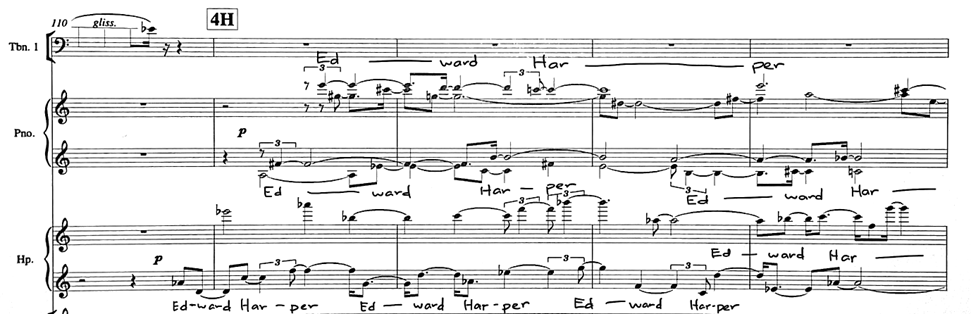
Bars 110–114 from the 4th movement, with my annotations. Adapted from “Addolorato” (p. 53), Concerto for Piano and Orchestra, 2010, SOUNZ. Copyright 2010 by the estate of Lyell Cresswell.
This style of writing appears as a more advanced development from an earlier 1998 work entitled Acquerello. Named after a watercolour painting technique, this is another example of the composer’s fondness for other art forms, and we see how he developed this as a 6-voiced fugue in his first piano concerto.
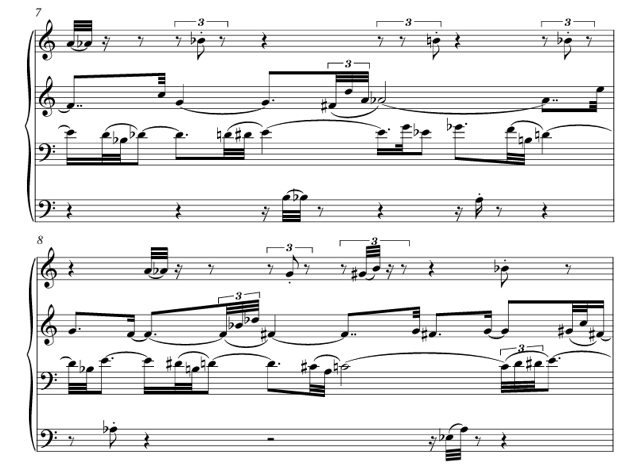
Acquerello for solo piano. Adapted from Acquerello (pp. 7–8), 1998, SOUNZ. Copyright 1998 by the estate of Lyell Cresswell.
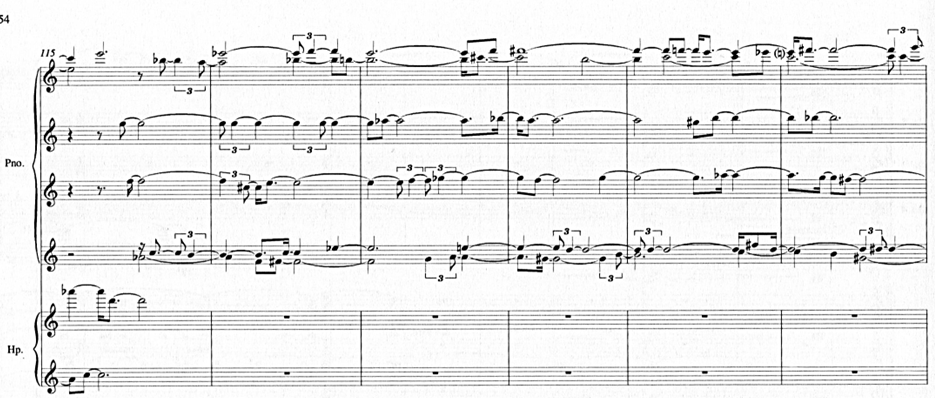
Bars 115–120 from the 4th movement. Adapted from “Addolorato” (p. 54), Concerto for Piano and Orchestra, 2010, SOUNZ. Copyright 2010 by the estate of Lyell Cresswell.
Translated as ‘sorrowful’ or ‘grieved’, Addolorato is placed at the central position of the entire concerto. It is literally and metaphorically the heart of the work. Cresswell contemplates that during the process of writing instrumental music, he tends to work from the inside out (i.e. from a central movement), citing that it gives him a sense of direction of where the music is leading toward (Wilson, 2014).
Beethoven, in his five-movement String Quartet Op. 132 similarly reserved the central movement as the emotional heart of his composition. It is titled “Holy song of thanksgiving of a convalescent to the Deity, in the Lydian mode”, as prior to its composition, the composer had been seriously ill and believed that he was going to die. Cresswell’s central movement also contains certain sections where the intimate scoring recalls that of a string quartet:
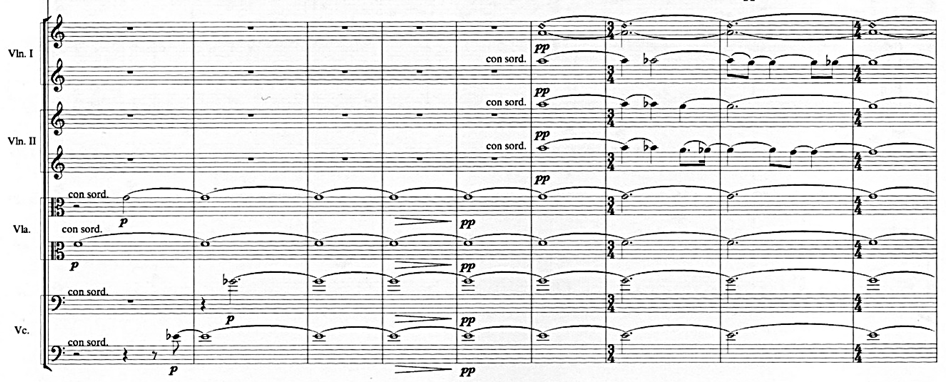
Bars 101–109 from the 4th movement. Adapted from “Addolorato” (p. 53), Concerto for Piano and Orchestra, 2010, SOUNZ. Copyright 2010 by the estate of Lyell Cresswell.
Movement Five: Scherzo II
The second scherzo is fast, lighter than the first and has a fleeting way about it. About nine years before Cresswell composed his first piano concerto, he wrote a quintet for piano and string quartet titled And every sparkle shivering [ww.youtube.com/watch?v=dmod5wJjIZA]. The piano quintet ensemble functions well as a mini-orchestra, and thus this work can be seen as a prototype of the composer’s later piano concertos. Indeed, Cresswell commented that the piano quintet “…has the scale of an orchestral piece… but the sound palette is of course reduced. You can’t bang a gong or hit a tamtam, so the challenge is to produce colour with more limited resources” (Shaw, 2000). This lends confirmation that the composer approached his composition in terms of musical colours or textures. In the following, we find a style of writing containing fast overlapping runs – I will refer to this instrumental texture as ‘mad cicadas’.
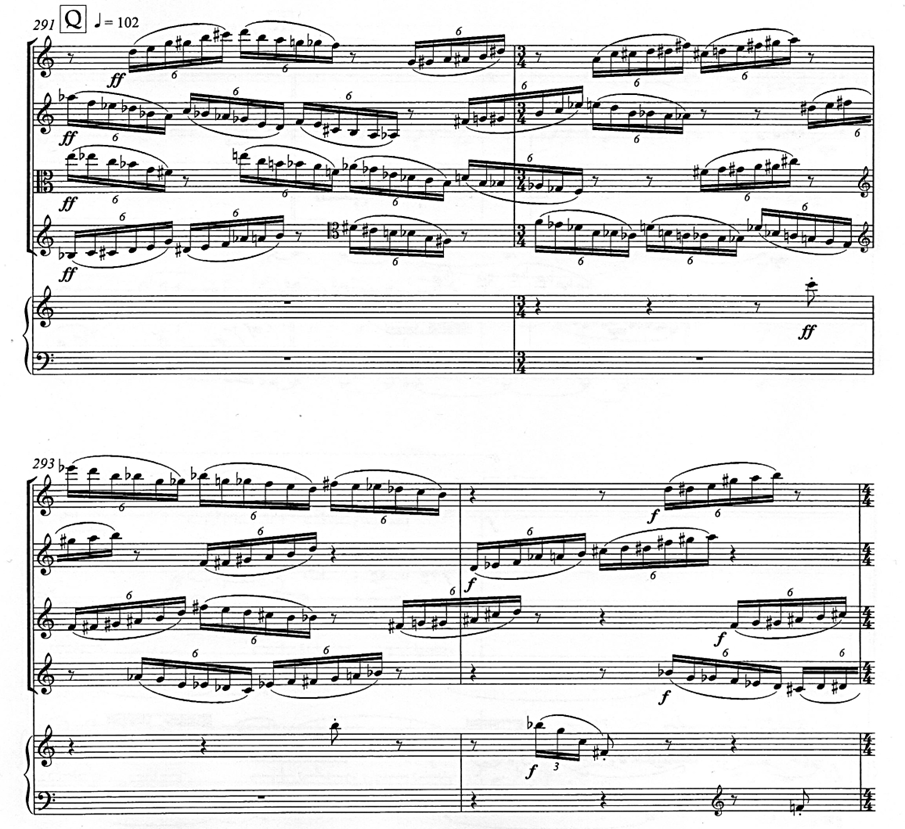
Bars 291–294 from ‘And every sparkle shivering’. Adapted from And every sparkle shivering (p. 19), 1999, Wai-te-ata Music Press. Copyright 1999 by the estate of Lyell Cresswell.
With additional instruments and timbres available in the concerto, Cresswell took this mad cicada idea and exploded it onto an enlarged canvas.
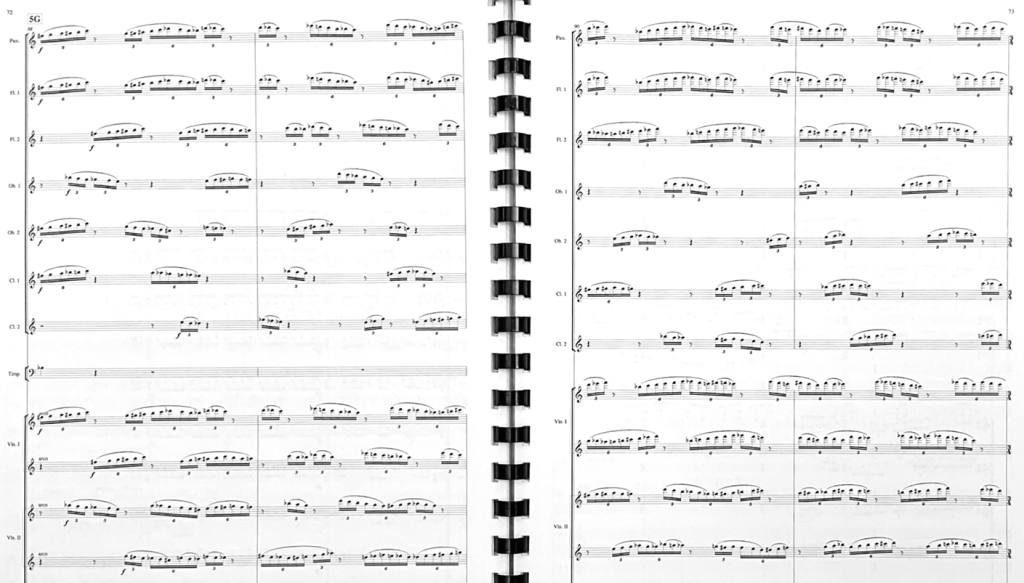
Bars 88–91 from the 5th Movement. Adapted from “Scherzo II” (pp. 72–73), Concerto for Piano and Orchestra, 2010, SOUNZ. Copyright 2010 by the estate of Lyell Cresswell.
Perhaps the composer also took inspiration from Witold Lutosławski’s Concerto for Piano and Orchestra, a modern masterwork in its own right, composed some twenty years earlier:
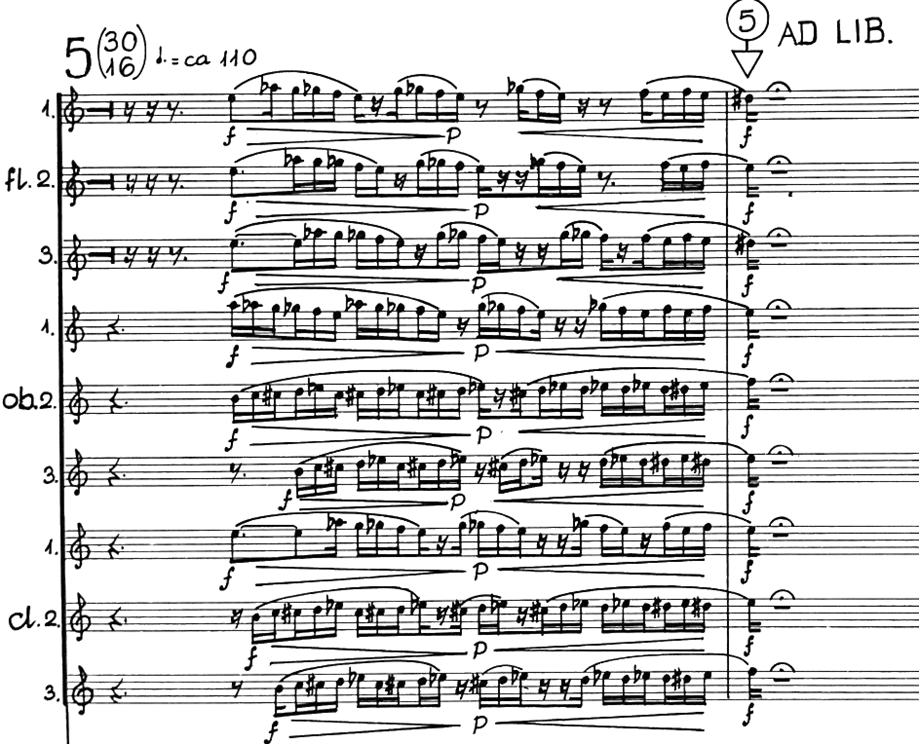
Ending of bar 4 from Lutosławski’s Piano Concerto. From Concerto for Piano and Orchestra (p. 6) by W. Lutosławski, 1987, Chester Music Limited. Copyright 1991 by Chester Music.
Amongst the fully fleshed-out orchestral textures of this movement, a brief moment stands out in striking contrast. Here, innovative scoring sees a solo piccolo sing out the E. H. motif (the first name, Edward, is uttered twice):
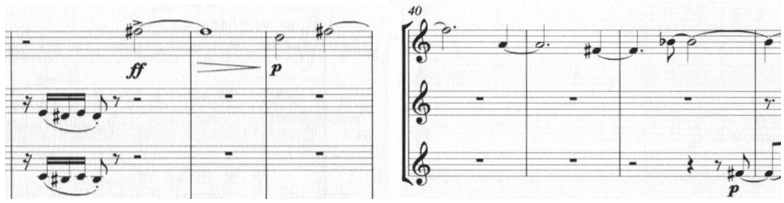
Bars 37–42 from the 5th Movement, piccolo on the top staff, treble clef. Adapted from “Scherzo II” (pp. 64–65), Concerto for Piano and Orchestra, 2010, SOUNZ. Copyright 2010 by the estate of Lyell Cresswell.
This is perhaps the most important point of the entire work, occurring at 17’47” in the recording by De Pledge, New Zealand Symphony Orchestra & McKeich (2014), which corresponds almost exactly with the golden section, timed at 18’14”. Considering Cresswell’s precise, engineer-like approach to composition, as well as his respect for J. S. Bach (who also paid attention to the golden ratio in his compositions), this is likely not a coincidence. The composer saved the most significant moment of Piano Concerto No. 1 for a haunting, solitary line, almost as if he were calling out to a friend who exists in another dimension.

Cresswell’s concerto timings, according to the official recording
While not obvious at a surface level, Cresswell considered himself a primarily melodic composer (S. De Pledge, personal communication, September 19, 2025), and this dramatically beautiful moment testifies to this fact. In an orchestral context, “[p]iccolos are used on the melody to create an American patriotic or military feel, or to create a pixiesh [sic], puckish or childlike feel” (Alexander & Melillo, 2009, p. 426). Cresswell, always the explorer, managed to cleverly discover a completely different role for an instrument that has been somewhat pigeonholed in orchestral contexts. Notably, in a 1991 work called Ylur, which itself explores the theme of sorrow, the composer also employs the piccolo (supported by other instruments). The melody depicts sobbing, painful emotions and is written under the subtitle Piangente, which translates to ‘crying’:

Bars 9–15 from the 4th Movement of Ylur. Adapted from“Piangente”(p. 68), Ylur, 2007, Wai-te-ata Music Press. Copyright 1991 by the estate of Lyell Cresswell.
Cresswell further expands the E. H. motif in a highly complex passage for winds in which the shape of the motif gets truncated, distorted and fragmented. It is as if one is fighting and processing the endless thoughts of the deceased. This is an incredible example of the composer’s dedication to his craft and his integrity as an artist. Despite the fast tempo of this passage and thus inherent inaudibility of many of the contrapuntal details, he committed himself to the utmost quality of craftsmanship. Any single line of counterpoint can hold its own and sustain interest even when it stands alone.
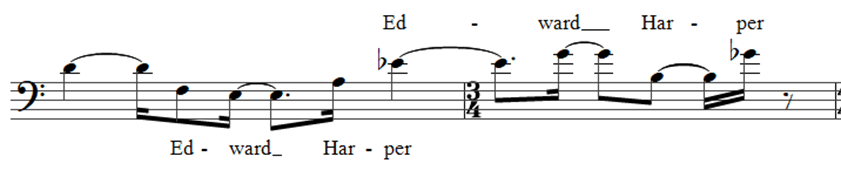
Bassoon line, bars 54–55 of the 5th movement setting
It is fascinating to recall that Cresswell appreciated marquetry and even considered doing it as a profession, citing that the designing and inlaying of random, exotic materials to create a decoration was related to the way that music is constructed (Cresswell, Whitehead & Askew, 2024). In the following passage, we see the remarkable detail of the composer’s work in his ‘musical marquetry’:
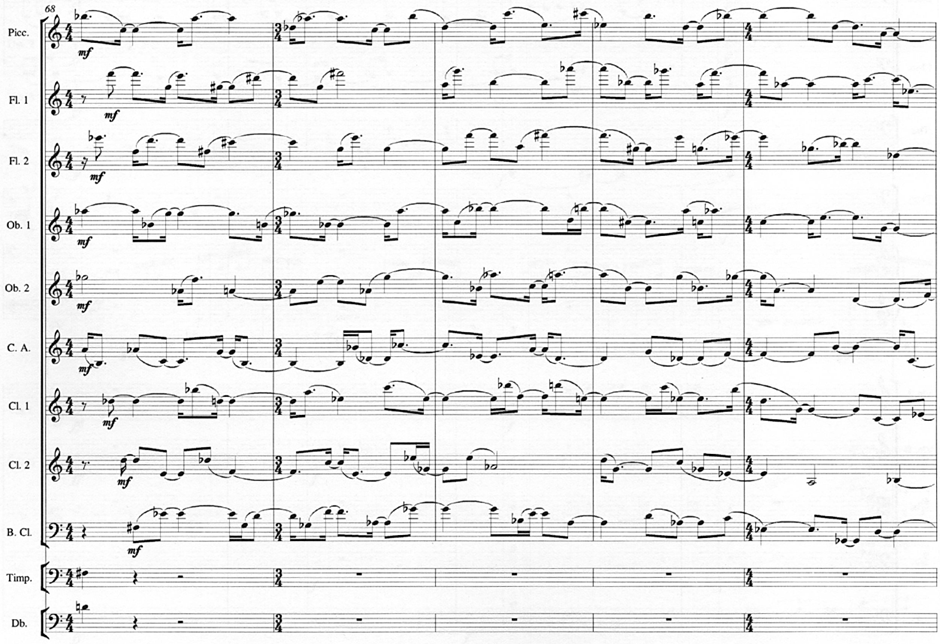
Bars 68–72 from the 5th Movement. Adapted from “Scherzo II” (p. 67), Concerto for Piano and Orchestra, 2010, SOUNZ. Copyright 2010 by the estate of Lyell Cresswell.
Referring to the fifth stage of grief, this is when normalcy begins to return. Turbulent emotional ups and downs diminish as practical demands and daily routines return. This movement can be seen as a representation of the composer’s progress toward normalcy and healing from a state of mind marked by dejection.
Movement Six: Adagio II
As a mid-career composer, Cresswell was fortunate to have received financial support from the Dutch Government, which enabled him to live in Utrecht for a year. He quipped that he ”…liked living in Holland, though the actual course was frustrating because there were too many people around. [He doesn’t] like being crowded and [living in] Aberdeen had given [him] a lot of space ” (Staff, 1991). We can sense this in this movement, where the composer seems to suspend the listener’s perception of time with harmonies that simply sit still in the air (see below). The structure of the second scherzo is the reverse of the first scherzo and has the piano start with a solo before the strings answer with their unsettling harmonics.

Beginning the 6th movement. Adapted from “Adagio II” (p. 84), Concerto for Piano and Orchestra, 2010, SOUNZ. Copyright 2010 by the estate of Lyell Cresswell.
In the sixth stage of grief, reframing, reconstruction and working through are key aspects towards the healing process. One might begin to focus on personal growth and redirect time and energy into activities that are meaningful to them. The soft, contemplative rhythm of the beginning once again suggests the composer’s late friend’s name, though this time it’s a quiet, vigil-like annunciation:

Rhythmic pattern from the beginning of the 6th movement.
Referring back to Chiaroscuro, we see a progression of densely voiced chords in the high register, as a sonic parallel to the artistic method of using light and shadow to create the illusion of three-dimensionality on a two-dimensional medium:
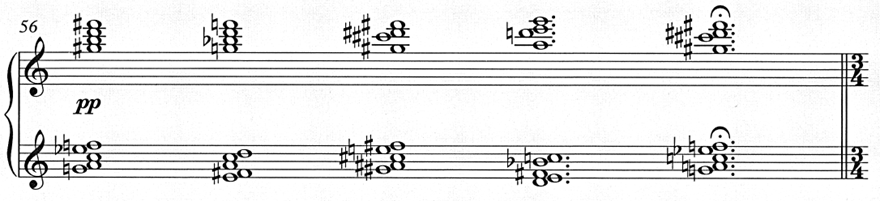
Bar 56 from Chiaroscuro. Adapted from “Chiaroscuro” (p. 25), Landscape Preludes, 2011, Score. Copyright 2005 by the estate of Lyell Cresswell.
In the concerto, with a full orchestra behind the piano, Cresswell could create a more distinctive contrast between musical light and shadow. To counter the piano, the strings’ harmonics provide ‘shadow’ while downward slides in the muted trombone depict deep angst. Note the subtle, otherworldly delivery of the E. H. motif by the first trombone:
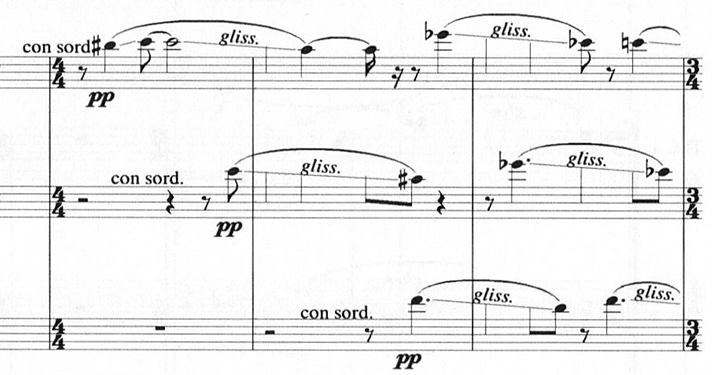
Bars 29–33 from the 6th movement, Trombones I, II, III in bass clef. Adapted from “Adagio II” (p. 85), Concerto for Piano and Orchestra, 2010, SOUNZ. Copyright 2010 by the estate of Lyell Cresswell.
The following example shows sliding trombone effect that the younger Cresswell used, in my opinion, rather extravagantly in Salm, his first work in which he found his own voice as a composer (Wilson, 2018). As time went on, however, the composer took ideas such as this and used them more sparingly, so in effect, he could say more with less.
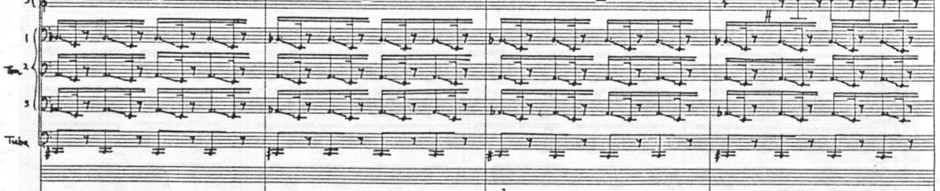
Bars 109–112 from Salm. Adapted from Salm (p. 42), 1977, Wai-te-ata Music Press. Copyright 1988 by the estate of Lyell Cresswell.
Following a brief climax, woodwind instruments work together to present a barely audible variation of the E. H. motif. They create a sustained effect like that of an organ, perhaps in homage to the soundworld of J. S. Bach:

Pitches of the final iteration of the E. H. motif from the 6th movement.
Movement Seven: Presto
The seventh and final stage of grief is about acceptance. At this stage, one hopes not to forget the past and to integrate, or even cherish, the memories of the deceased into one’s life. The final movement of the concerto is structured in ABA form, and Cresswell reuses sonic blocks such as ‘granite tuttis + chromatically saturated high woodwinds’:
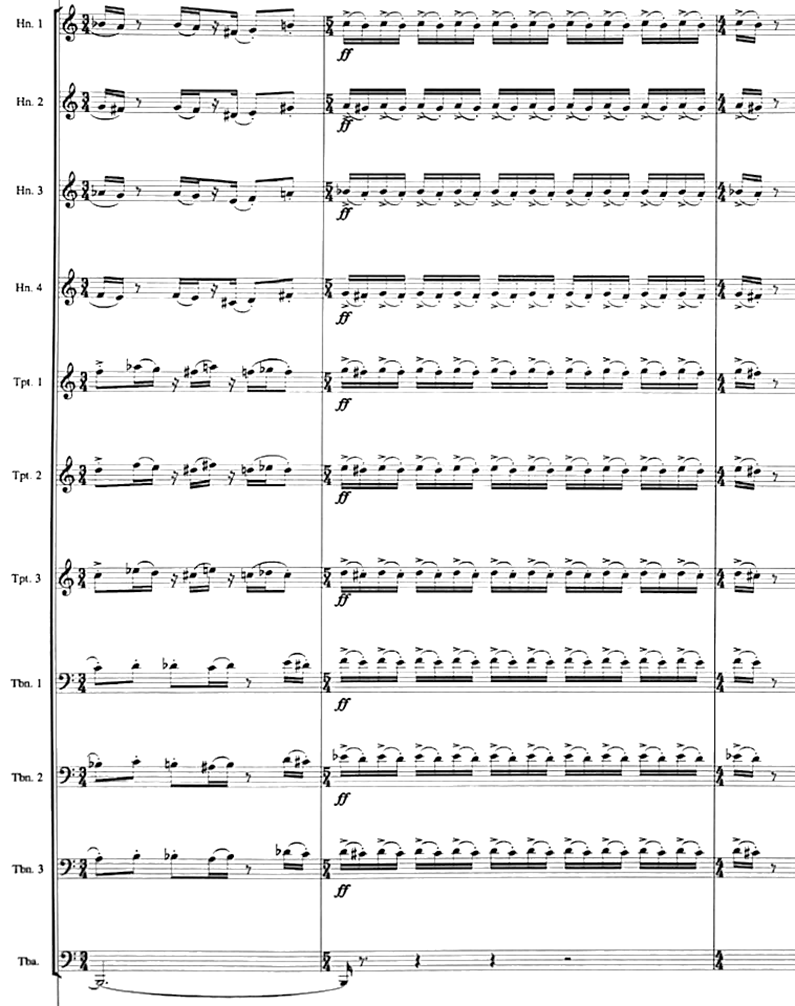
Granite tutti, bars 85–87 from the 5th movement. Adapted from “Scherzo II” (p. 71), Concerto for Piano and Orchestra, 2010, SOUNZ. Copyright 2010 by the estate of Lyell Cresswell.
What I term ‘granite tuttis + chromatically saturated high woodwinds (GT+CSHW)’ is a textural feature first encountered in bars 66–74 of the opening movement, and also found in the fifth movement as well. In this movement, it is juxtaposed against the ‘hand chasing’ texture. Complete contrast is achieved in section B, where the dense sounds of low instruments can be traced back to the ‘repose chord’ from the second movement. Stern granite chords also make a brief cameo in the low brass. Also heard is a reference to the ‘question and answer’ feature from the second movement occurs in bars 96–119. The final section of the work, an extended coda, turns out to be a great demonstration of ‘musical marquetry’, combining various elements heard earlier in the concerto. The following table offers a summary of the features of this movement.

Sections of the 7th movement (not to timing scale)
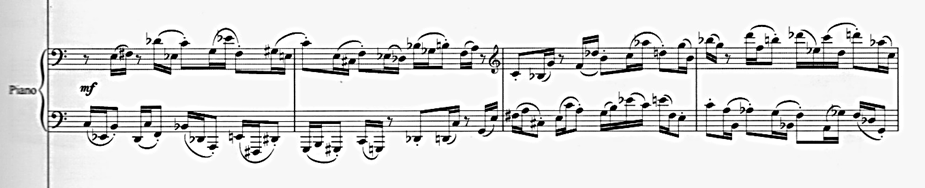
Hand chasing texture, bars 156–159 from the 7th Movement. Adapted from “Presto” (pp. 113–114), Concerto for Piano and Orchestra, 2010, SOUNZ. Copyright 2010 by the estate of Lyell Cresswell.
A dance-like theme, derived from the E. H. motif, is presented by the piano to begin the coda. Here, Cresswell spotlights the piano’s percussive properties. We can trace this compositional technique back to a song composed over some 20 years earlier:
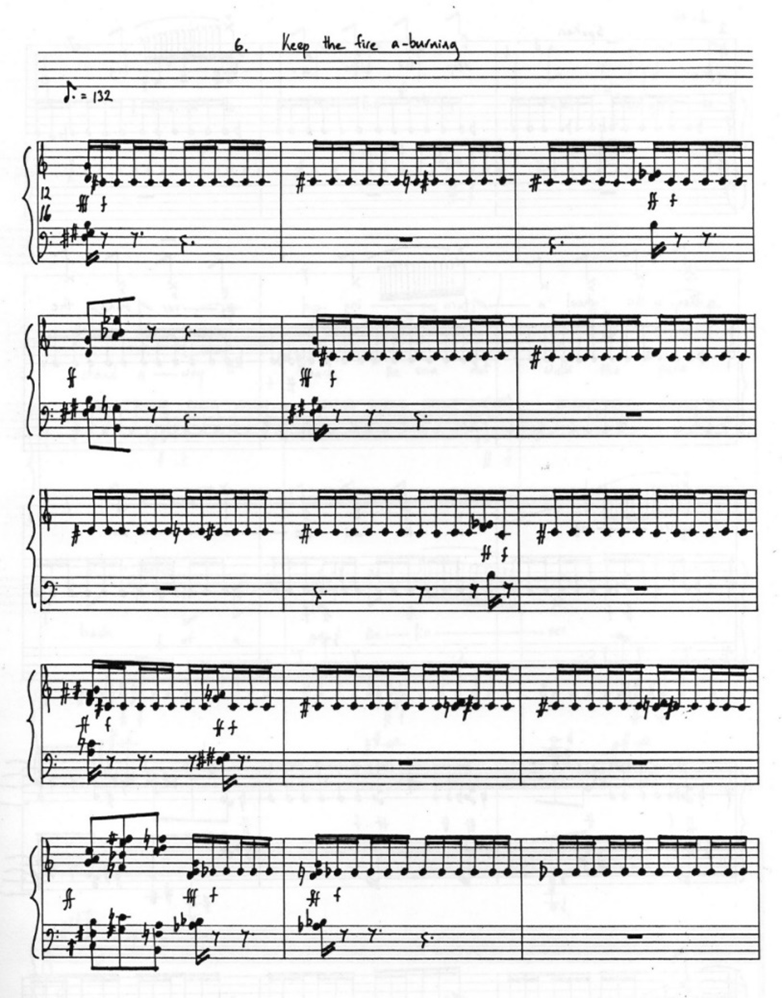
First page from Keep the fire a-burning. Adapted from “Keep the fire a-burning” (p. 15), Eight Shaker Songs, 1985, Scottish Music Centre. Copyright 1985 by the estate of Lyell Cresswell.
Numerous iterations of the E. H. motif can be discovered, including in the harp part of the following excerpt, but are mostly overshadowed by the dance-like theme. With an emphasis on repeated Gs, the music obstinately interrupts the E. H. motif when it tries to rear its head, while sleigh bells, which took on a sinister effect in the previous movements, now actually sound joyous.
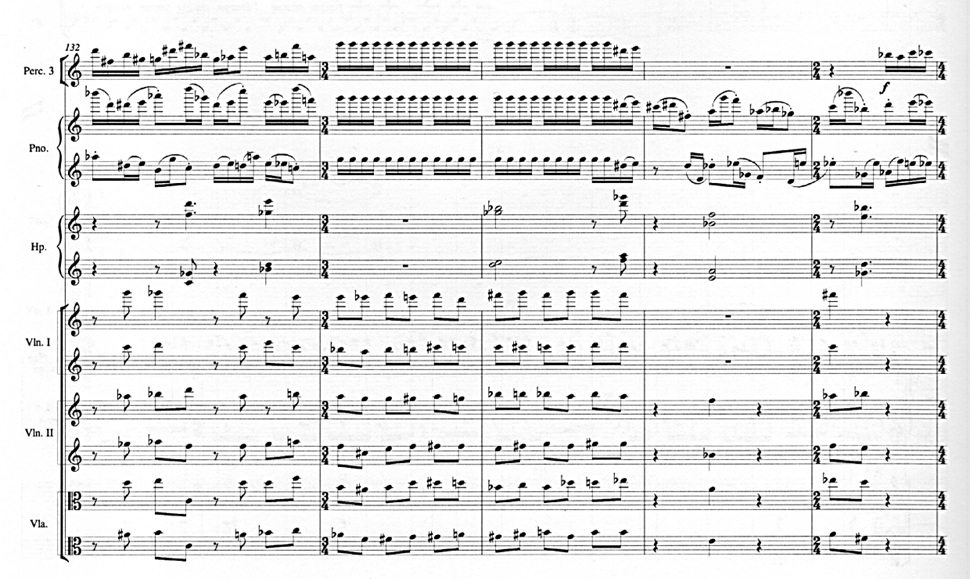
Bars 132–136 from the 7th movement. Adapted from “Presto” (p. 108), Concerto for Piano and Orchestra, 2010, SOUNZ. Copyright 2010 by the estate of Lyell Cresswell.
Cresswell refrains from a bloated send-off by keeping tuttis short, contrapuntal textures transparent, resisting the overuse of bass notes and avoiding the triumph-over-adversity finales opted for by many composers of large-scale works.
Final Form
De Pledge confirms that despite being note-wise, the hardest concerto he had ever played in live performance, everything came together seamlessly (S. De Pledge, personal communication, September 19, 2025). This is a testament to the composer’s familiarity with the practical nature of performance. For the most part, this concerto is written in 4/4 or 3/4 time, in comparison to his early violin concerto, where the 25-year-old composer used tricky time signatures such as 25 quavers in a bar – a meter which does not necessarily facilitate the rehearsal/performance process.
Cresswell remarked that his way of composing always involved putting his thoughts down on paper, and he would end up with pages and pages of writing, drawings, and crossings-out (Scottish Chamber Orchestra, 2012), as evident in the following example. He reflected that as a young person, his “…real pleasure… came from listening to… band music and writing down musical patterns” (Cresswell, 2024, p. 167). Despite his somewhat quirky and idiosyncratic nature, he had a well-organised way of thinking and considers that “[c]omposers examine the world through their ears [which] nourish their emotions, but investigations have to have the same seriousness of purpose as any scientific inquiry… every detail has to be considered… (Cresswell, Whitehead & Askew, 2024, p. 156).
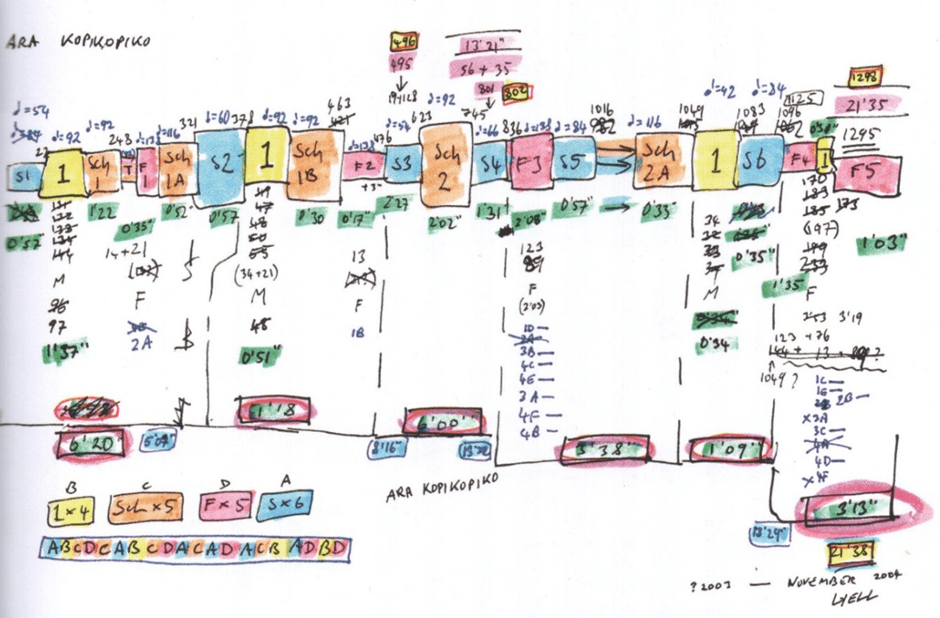
An example of Cresswell’s plan for one of his compositions. From Divagations, Doodlings, and Downright Lies (p. 121), 2024, Te Herenga Waka University Press. Copyright 2024 by the estate of Lyell Cresswell.
As a non-tonal composition, Piano Concerto No. 1 successfully unifies the various sections through a single motif, while sustaining interest by shifting the register and orchestrational textures. Using colours to depict my personal emotional responses, the following is my reverse-engineered compositional plan, outlining how I would structurally map out the entire work:
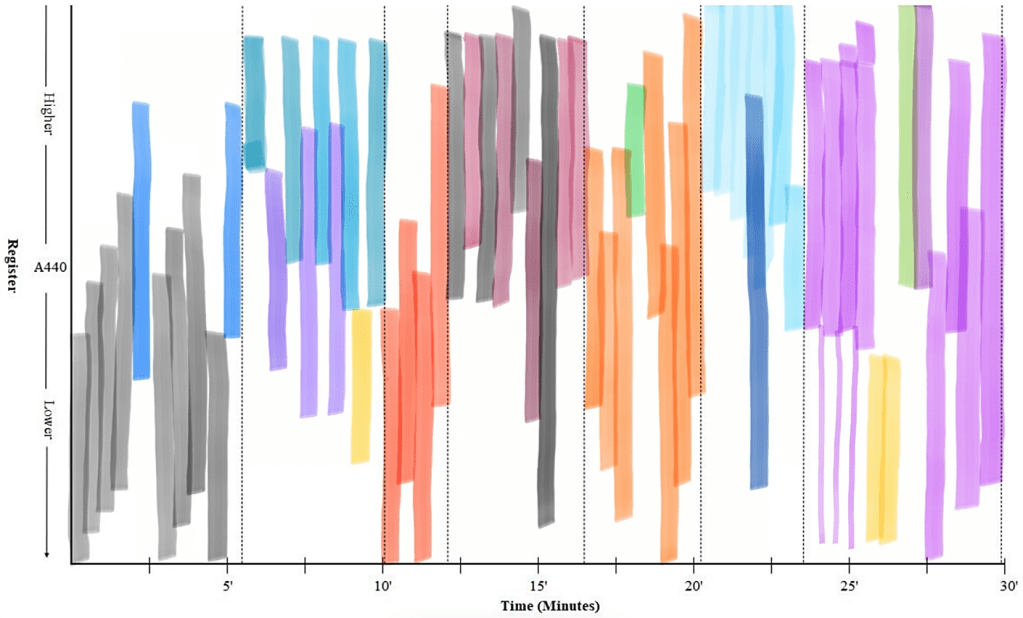
Registral and textural design of Cresswell’s Piano Concerto No. 1
As a possessor of a highly individual and original mind, Lyell Cresswell avoids every possible piano concerto cliché, leaving the listener reinvigorated after witnessing a profound emotional journey. Piano Concerto No. 1 certainlystands as the ‘El Capitán’ amongst a varied, yet marvellous repertoire of New Zealand piano concertos. In fact, to this day, audience members who were at the premiere still speak glowingly about the experience (S. De Pledge, personal communication, September 19, 2025). While audio recordings are an excellent supplement, the nature of the concerto genre meant that these works were designed for live performance. Theatricality, sonic layering, and the charisma of the soloist and orchestral players are an integral part of the presentation – perhaps more so than straight symphonic, choral, or chamber works.
In the twentieth century, composition and performance became more specialised disciplines, which meant that modern piano concertos have largely been performed by professional pianists, and not by their composers. Since the conclusion of World War II, notable piano concertos include: Piano Concerto (1962) by Samuel Barber, premiered by John Browning; Concerto for Piano and Orchestra (1988)by György Ligeti, premiered by Anthony di Bonaventura; and Concerto for Piano and Orchestra (1988) by Witold Lutosławski, premiered by Krystian Zimerman. Cresswell’s masterwork and De Pledge’s compelling performance undoubtedly hold their own among this international field of modern piano concertos.
List of References
Alexander, P. L., & Melillo, S. (2009). Professional orchestration. volume 2B, The second key: orchestrating the melody within the woodwinds & brass. Alexander Publishing.
Askew, S. (2024, August 24). Divagations, Doodlings and Downright Lies [Radio broadcast]. RNZ. https://www.rnz.co.nz/concert/programmes/three-to-seven/audio/2018952762/divagations-doodlings-and-downright-lies
Chissell, J. (1996). The Symphonic Concerto: Schumann, Brahms and Dvořák in “A Companion to the Concerto, ed. Robert Layton”. Oxford University Press.
Cresswell, L. (2018). Concerto No. 1 for Piano and Orchestra. SOUNZ. https://sounz.org.nz/works/20417
Cresswell, L., Whitehead, G. & Askew, S. (2024). Divagations, doodlings and downright lies. Te Herenga Waka University Press.
De Pledge, S., New Zealand Symphony Orchestra, McKeich, H. (2014). Landscapes of the Soul / Piano Concerto / Concerto for Orchestra and String Quartet [CD]. Naxos.
Holloway, S. et al. (2011). Landscape Preludes: Music for Piano [Musical score]. Holloway, S. Score.
Keefe, S. P. (2005). Theories of the concerto from the eighteenth century to the present day. In S. P. Keefe (Ed.), The Cambridge Companion to the Concerto (pp. 5–18). Cambridge University Press. https://doi.org/10.1017/CCOL9780521834834
Kerr, E. (2022, April 9). Obituary: Lyell Cresswell, composer who always aimed to strike a chord. Stuff.co.nz. https://www.stuff.co.nz/entertainment/music/128287186/obituary-lyell-cresswell-composer-who-always-aimed-to-strike-a-chord
Kim, J. (2012). Contemporary New Zealand Piano Music: Four Selected Works from Twelve Landscape Preludes: Landscape Prelude, the Street Where I Live, Sleeper and the Horizon from Owhiro Bay [DMA dissertation, Florida State University]. Florida State University Libraries._https://docslib.org/doc/4759487/contemporary-new-zealand-piano-music
Lochhead, J. I. (2016). Reconceiving Structure in Contemporary Music: New Tools in Music Theory and Analysis. Routledge. https://doi.org/10.4324/9781315740744
Radich, E. (2011, May 12). Lyell Cresswell and Stephen De Pledge [Radio broadcast]. RNZ. https://www.rnz.co.nz/concert/programmes/upbeat/audio/2489021/lyell-cresswell-and-stephen-de-pledge
Rakochi, V. (2021). Orchestration as a Means of the Synthesis of Classical and Romantic Approaches in Brahms’ Second Piano Concerto. Muzikološki Zbornik, 57(1), 25–63. https://doi.org/10.4312/mz.57.1.25-63
Schneider, D. E. (2005). Contrasts and common concerns in the concerto 1900–1945. In S. P. Keefe (Ed.), The Cambridge Companion to the Concerto (pp. 139–160). Cambridge University Press. https://doi.org/10.1017/CCOL9780521834834
Scottish Chamber Orchestra. (2012, October 9). Lyell Cresswell and Rob Butlin. YouTube. https://www.youtube.com/watch?v=W676i7v_2qU
Shaw, P. (2000, October 28). Love’s fire burning: Lyell Cresswell celebrates 50 years of chamber music. Listener.
Staff, T. H. (1991, December 18). From postman to composer. The Herald. https://www.heraldscotland.com/news/12650413.from-postman-to-composer/
Tumelty, M. (2012, March 9). Cresswell’s concerto Memorial for Close friend. https://www.heraldscotland.com/life_style/arts_ents/13049799.cresswells-concerto-memorial-close-friend/
Whittall, A. (2005). The concerto since 1945. In S. P. Keefe (Ed.), The Cambridge Companion to the Concerto (pp. 161–174). Cambridge University Press. https://doi.org/10.1017/CCOL9780521834834
Wilson, C. (2014, October 14). Composer of the Week: Lyell Cresswell (b. 1944) [Radio broadcast]._RNZ._https://www.rnz.co.nz/concert/programmes/composeroftheweek/audio/20152659/lyell-cresswell-b-1944
Wilson, C. (2018). Lyell Cresswell: Music for String Quartet [CD booklet]. Delphian Records Ltd.
Young, K. (2014, November 11). Kenneth YOUNG: Piano Concerto (Introduction) [Radio broadcast]._RNZ._https://www.rnz.co.nz/concert/programmes/resound/audio/20156784/kenneth-young-piano-concerto-introduction
