Lyell Richard Cresswell’s Piano Concerto No. 1 is New Zealand’s most recognised and successful concerto for piano and orchestra, and is one of, if not the Nation’s greatest concertante work. It is a composition that has received several live performances, two recordings, published scores and New Zealand’s most coveted prize for composition.
Born in New Zealand in 1944, Cresswell first received international recognition in 1978 with his composition Salm, and subsequently made a living as a professional composer based in Europe. His first Piano Concerto No. 1 was completed in 2009 and premiered in both New Zealand and Scotland in 2011. It is a large-scale composition that received a video recording with pianist Stephen De Pledge and the Christchurch Symphony Orchestra[1], an audio recording with De Pledge and the New Zealand Symphony Orchestra[2], print publications by both SOUNZ and the Wai-te-ata Music Press, as well as the 2011 SOUNZ Contemporary Award[3]. It is New Zealand’s most successful piano concerto to date.
Significant works of art rarely, if ever, just appear out of the blue. Musicologists tasked with investigating great musical compositions use various methods to throw light on the origins and progression toward the final product. For example, the magnificent last movement from Mozart’s final Symphony contains a theme that can be traced back to his very first symphony, which in turn can be traced back to an old plainchant. My investigation will employ a qualitative, critical approach and is grounded in the belief that, to quote Judy Lochhead, what we “…write or say about music, how [we] graphically depict music’s sounding, or how [we] physically embody musical sound… affect how people experience music” (Lochhead, 2016, p. 3).
Cresswell’s work was commissioned by New Zealand linguist and philanthropist Jack C. Richards for Stephen De Pledge. De Pledge is an internationally recognised performer who has commissioned, performed, recorded and published over a hundred contemporary compositions. He first encountered Cresswell’s music as a 15-year-old violist in the National Youth Orchestra and was “…completely blown away…” (Radich, 2011) by the soundworld created by the composer. De Pledge described the experience of performing Cresswell’s first piano concerto as “…quite simply one of [his] favourite music experiences ever” (Cresswell, Whitehead & Askew, 2024, p. 226) and considers it to be New Zealand’s greatest piano concerto (Kerr, 2022).
Cresswell dedicated Piano Concerto No. 1 to the English composer and conductor Edward Harper, whose death on Easter Sunday, 2009, affected him deeply. Harper had been very supportive during the early stages of Cresswell’s career and would eventually become like a brother to him (Wilson, 2014). During the acceptance of his laureate award in 2016, Cresswell stated that “[w]hen I write music, I am writing my autobiography. If I were to use words, I would tell a pack of lies, but when I write music, I find it impossible to lie…” (Kerr, 2022). He added that “…in a strange way the whole concerto was written under the shadow of [Harper’s death],” but goes on to clarify that the work is “…also a celebration of Edward’s life as much as anything…” (Tulmelty, 2012).
Prior to the first piano concerto, Cresswell had written a number of orchestral works and concertos for accordion, string quartet and trombone, among others. He wrote a small number of solo piano works, most significantly, a suite of pieces[1] inspired by the painting and artistic techniques (the composer himself was excellent at drawing and painting). In these piano ‘studies’, he developed a way of writing which would be expanded in his first piano concerto.
Piano Concerto No. 1 is scored for solo piano and a large orchestra consisting of Woodwinds 3,3,3,3 | Brass 4,3,3,1 | Timpani | 3 Percussionists[1] | Harp | Strings. There are seven movements, which are played without a break and last approximately 30 minutes in performance. The inner movements, numbers 3, 4, 5 and 6 were written before Harper’s passing, during the last months of his life, when he was ill with terminal cancer.
Seven is a significant number in Christianity, and it is worth mentioning another significant seven-movement work by Cresswell, The Voice Within. This work,composed about a decade earlier, is also a concerto (for violin, soprano, and orchestra) and incorporates written text that speaks about personal emotions. The composer follows a similar format in his first piano concerto: both pieces start evocatively, conclude with a virtuosic final movement and sandwiched in between, are two scherzos as well as more contemplative movements which function as contrasting interludes (Table 1).
Table 1
Structural comparison between The Voice Within and Piano Concerto No. 1
| Movement | The Voice Within | Piano Concerto No. 1 |
| 1 | Invocation | Funeral March |
| 2 | Scherzo I | Adagio I |
| 3 | Vigorous | Scherzo I |
| 4 | Slow Movement | Addolorato |
| 5 | Scherzo II | Scherzo II |
| 6 | Burlesque | Adagio II |
| 7 | Plea | Presto |
The choice to write a piano concerto for a deceased friend may seem unlikely, given the genre’s nature. From its inception to the present day, Keefe (2005) observed that the concerto form, in broadest terms, provides “…a vehicle for the solo performer(s) to demonstrate their technical and musical proficiency; in practical terms, concertos demonstrate multifarious types of solo–orchestra interaction and virtuosity…” (p. 7). Furthermore, Schneider (2005) observed that concertos for solo string instruments are more likely to deal with the subject of death (and transfiguration).
However, some five years prior, there was a premiere of another piano concerto[2] by New Zealand composer Kenneth Young, whose mother was also dying from cancer during the writing of the piece. Young poignantly reflected that the second movement “…expresses what [he] felt at the time” (Young, 2014). His mother passed away a day after the premiere of the concerto.
Jenny McLeod’s[3] Rock (Piano) Concerto wascompleted in 2009 – approximately the same time Cresswell was working on his concerto. The second, slow movement, titled ‘Elegy for Charlie French’ was written in memory of her close friend who had died of AIDS. Cresswell was well-connected with New Zealand musicians (S. De Pledge, personal communication, September 19, 2025) and always tried to return home when he could (Wilson, 2014), so it is likely he would’ve been aware of these works.
Considering the circumstances in which the first piano concerto was created, I propose a connection with the well-known psychological phenomenon known as the ‘Seven Stages of Grief”[4] as seen in Table 2. This is speculation on my part, of course, but I believe it is appropriate and can offer an interesting angle to view the overview structure and progression of the various sections.
Table 2
Comparison between movements and the Seven Stages of Grief
| Movement | Piano Concerto No. 1 | Seven Stages of Grief |
| 1 | Funeral March | Shock/Disbelief |
| 2 | Adagio I | Pain and Guilt |
| 3 | Scherzo I | Anger and Bargaining |
| 4 | Addolorato | Depression, Reflection |
| 5 | Scherzo II | The Upward Turn |
| 6 | Adagio II | Reconstruction & Working Through |
| 7 | Presto | Acceptance and Hope |
Movement One: Funeral March
Cresswell grew up with a father and uncle who were both bandmasters and four grandparents who were officers in the Salvation Army. As a result, he developed an enduring love of brass band music (Shaw, 2000) and admitted that this sound world influenced him as a mature composer (Wilson, 2014). The first movement of the concerto begins with sombre, clustered chords in the murky range of the piano and orchestra – a soundscape that was perhaps influenced by both the thick sounds of the brass bands and partly by the dramatic, fog-laden landscapes of Scotland, where the composer lived while he was working on this piece. Personally, I had experience playing in a Salvation Army Brass Band and can attest to the timbres the composer would have been familiar with growing up.
Just a few years prior to the composition of his first piano concerto, Cresswell was commissioned by De Pledge to compose a ‘Landscape Prelude’, and the resultant work was entitled Chiaroscuro. Chiaroscuro is a visual art method that the composer describes as “…light and shadow to create the illusion of three-dimensional objects” (Holloway et al., 2011, p. 20). Figure 5 shows the soft chords that begin this piece. These chords perhaps represent the ‘shadow’ and are a fine example of the composer’s multi-dimensional creative practice, where visual arts (as well as poetry) carried over to his musical sensibility.
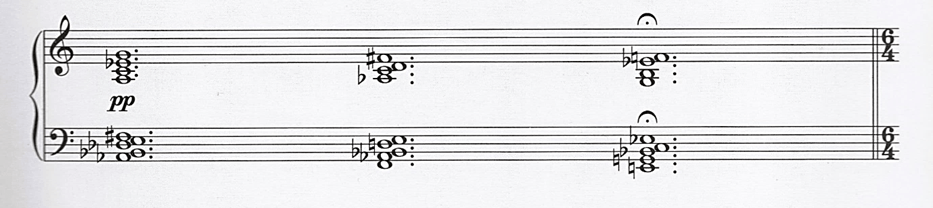
Beginning of Chiaroscuro Adapted from“Chiaroscuro”(p. 21), Landscape Preludes, 2011, Score. Copyright 2005 by the estate of Lyell Cresswell.
[1] temple blocks, sleigh bells, cowbell, tambourine, snare drum, glockenspiel, sleigh bells, maracas, 2 wood blocks, xylophone, sizzle cymbal
[2] https://www.rnz.co.nz/concert/programmes/resound/audio/20156785/kenneth-young-piano-concerto
[3] New Zealand Composer and a good friend of Cresswell’s, 1941–2022
[4] Originally called ‘Five stages of Grief’, an idea developed by Dr Elisabeth Kübler-Ross in the late 1960s
[1] Also recorded by Stephen De Pledge on Metier Met CD 1053 and Rattle Rat-D074
[1] https://www.youtube.com/watch?v=UI0-rAR9RPI
[2] Naxos CD 8.573199
[3] New Zealand’s most coveted award for composers
